Once fish stocks fall below 300 kilograms per hectare, their coral reefs may collapse and lose their productivity, providing an indicator of the "tipping point" for sustainable fishing, according to a new study.
The study, published in Proceedings of the National Academy of Sciences (PNAS), bases its conclusion on an analysis of the relationship between fish biomass and coral reef health in more than 300 shallow reefs in nine countries of the Western Indian Ocean, including Kenya, the Maldives, the Seychelles and Tanzania.
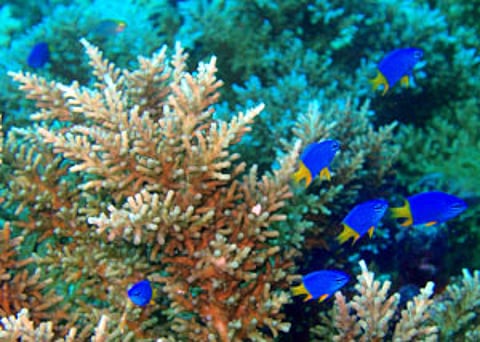
"Fish and coral interact in a kind of synergistic relationship," said M Aaron MacNeil, a research scientist at the Australian Institute of Marine Science (AIMS), who helped come up with the tipping point. "The corals provide habitat for protection and settlement, as well as food for the fish, while the fish graze the algae that corals compete with for space, and cycle nutrients through the system."
While healthy coral reefs allow for as much as 1,000-1,500 kilograms of fish per hectare, the reefs are vulnerable to overfishing and destructive fishing gear that can eventually destroy them, among other factors, SciDev.Net reports.
"When fished biomass is below 300 kilograms per hectare, we see a steep and rapid decline in reef ecosystems," said MacNeil.
To prevent this, countries must implement control measures against overfishing and be able to regulate the amount of fishers, catch and fishing techniques, said Tim McClanahan, senior conservation biologist of the World Conservation Society, who co-designed the research and co-authored the study.
The issue is trickier because most reefs are located in developing countries, such that food security concerns often trump conservation, the study explains. Small meshed nets or traps should be banned outright on reefs, and limits need to be placed on the number of fish that can be caught. Bans could also be instituted on harvesting certain species, McClanahan argued.
Aquaculture is an alternative to open fishing on reefs and could help conservation, but it also has its problems.
"It often has implications for the health of nearby habitats, or the need to catch large quantities of wild fish to feed the fish being cultured," said Nicholas Graham, senior research fellow of the Australian Research Council Centre of Excellence for Coral Reef Studies at James Cook University (JCU) and member of the research team.
Marine protected areas (MPAs) could be part of the answer. They have been successful in the western Indian Ocean region and in Kenya, said the researchers.
"Setting up MPAs can effectively reduce the time needed to replenish coral reefs," said Porfirio Aliño, a Filipino marine scientist who has surveyed several MPAs in South-East Asia and is lobbying lawmakers to build a network of them in the Philippines.
MPA size should be at least 10 percent of a reef area, he said, and if possible co-managed by various stakeholders sharing management costs. Vigorous legal enforcement and public education are also vital to detect and curtail destructive and illegal fishing.
FIS
