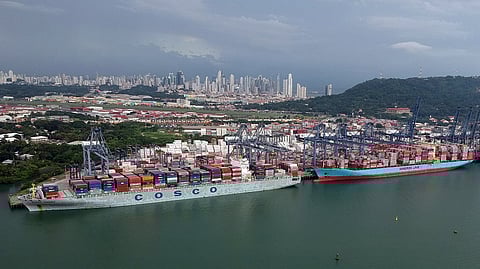


Panama's Supreme Court annulled last week CK Hutchison's contract to operate two Panama Canal ports at the heart of a $23-billion deal to sell the Hong Kong conglomerate's global port assets.
The contract held by Panama Ports Company (PPC), a CK Hutchison subsidiary, violated Panama's constitution by giving the company exclusive privileges and tax exemptions, the court said.
CK Hutchison, controlled by Hong Kong's richest man Li Ka-shing, announced a sale last March covering 43 ports in 23 countries, including two near the Panama Canal, to a group led by BlackRock and Italian Gianluigi Aponte's family-run shipping firm MSC.
After Beijing criticised the deal, the conglomerate said in July it was in talks to include a Chinese "major strategic investor" in the consortium.
Sources have said the Chinese investor is COSCO, and it was seeking a large stake, while the others were keen for it to be a minority shareholder, a position that became a sticking point in talks.
COSCO did not respond to a request for comment.
Shares of CK Hutchison have dropped more than eight per cent since the court's ruling, although it is still trading at its highest since June 2021. It is up nearly 60 per cent since the sale was announced, as investors banked it would earn the company more than $19 billion in cash.
The deal opened a new front in contention between the US and China, as they grapple for control of the world's most important trade routes. CK Hutchison's Balboa and Cristobal ports are considered strategic assets in the Panama Canal, the main seaborne trading route into the US. Balboa is at the canal's Pacific entrance while Cristobal is at the Atlantic entrance.
More than 40 per cent of US container traffic, valued at roughly $270 billion a year, transits the canal, making it critical for US supply chains.
President Donald Trump initially celebrated CK Hutchison's proposed sale to Blackrock and MSC, saying he wanted to retake control of the strategic waterway.
American lawmakers have previously said CK Hutchison's control of the ports was a security risk for canal operations.
The court decision was welcomed by US authorities and John Moolenaar, chair of the US House Select Committee on China, called it a "win for America."
In a clear sign of China's unease, Beijing had said it would work to block the transaction unless Chinese ownership was involved.
On Friday, China's foreign ministry said it would take "all necessary measures" to defend the rights and interests of Chinese enterprises.
Hong Kong's government said it strongly opposed any foreign government using "coercive" means to harm the territory's business interests.
While the two ports account for just five per cent of Hutchison Port Holdings' earnings before interest, tax, depreciation and amortisation (EBITA), their strategic importance is high.
PPC said it reserved the right to begin national and international legal proceedings after the court ruling, and analysts said the port company cannot appeal the decision, but can seek clarifications that could slow termination.
It is unclear how losing the ports will affect CK Hutchison's global ports deal, but some analysts, including JPMorgan and Citigroup, said it would be easier for parties to agree terms with Panama out of the picture.
All parties are still in talks on the sale of CK Hutchison's ports, said a person with direct knowledge of the transaction, who spoke on condition of anonymity.
Besides the Panama ports, other strategic assets in the portfolio up for sale include ports in Rotterdam in the Netherlands, Barcelona in Spain, Mexico and the Bahamas.
CK Hutchison's China ports are significant, but are not part of the sale.
One option in the latest discussions is that the parties consider breaking up the portfolio and have the three bidders hold stakes in different ports, said another source with knowledge of the matter.
CK Hutchison, MSC and Blackrock did not respond to requests for comment.
Sources have said it could take at least two years to clear all regulatory hurdles in view of the challenges, such as securing approval from anti-competition regulators in nearly 50 jurisdictions.
(Reporting by Clare Jim and Kane Wu in Hong Kong, Scott Murdoch in Sydney; Editing by Anne Marie Roantree and Clarence Fernandez)
