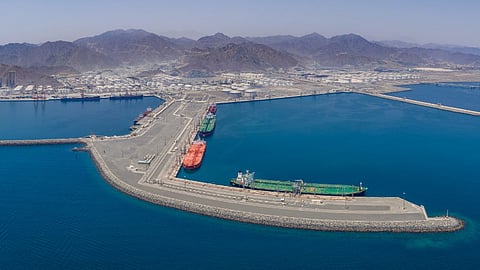


At the UAE port of Fujairah, conveyor belts offloaded grain from bulk carriers on Wednesday, while crude oil flowed through pipes and onto tankers berthed along its quay.
Dozens of loaded trucks lined up near the port and others parked outside waiting their turn, while offshore, vessels labelled COSCO, Gardenia and other shipping lines lay at anchor, service boats weaving between them.
Fujairah and Khor Fakkan, another eastern port with open access to the Indian Ocean, have become the UAE's economic lifeline since the effective closure of the Strait of Hormuz. They are now handling the bulk of the UAE's seaborne trade in place of the major terminals on the western coast inside the Persian Gulf, where ships have been stranded.
Since the start of the Iran war, crude exports through Fujairah have risen 38 per cent, pushing towards the upper limit of the pipeline that feeds the port.
At Khor Fakkan, terminal operator Gulftainer said the number of containers it handles has jumped roughly 25-fold.
Iran reminded the gulf region on Monday, however, just how exposed the ports are when its drones hit the Fujairah Oil Industry Zone, sparking a fire at one of the UAE's most critical energy facilities and injuring three workers.
Hours earlier, Iran's Revolutionary Guards Navy had published a map appearing to extend its zone of control along the UAE's eastern coastline, encompassing both ports. Shipping sources said on Tuesday that neither port had yet been affected, but the message from Tehran was clear.
The UAE foreign ministry directed Reuters' request for comment to official statements by UAE federal and Fujairah authorities, ADNOC and state news agency WAM.
Top UAE officials have repeatedly stressed that freedom of navigation in the Strait of Hormuz is a critical priority and have said they reserve the right to respond to attacks against the UAE.
"No country has the right to disrupt international trade flows or threaten supply routes," Energy Minister Suhail Al Mazrouei told a logistics forum in St. Petersburg last month.
Fujairah sits at the end of the Abu Dhabi Crude Oil Pipeline, which can carry between 1.5 million and 1.8 million barrels per day (bpd) from inland fields to the gulf of Oman, bypassing the strait and allowing the UAE's ADNOC to continue exporting oil to global markets.
Crude exports from Fujairah rose to an average of 1.62 million bpd by late March from 1.17 million bpd in February, Kpler analyst Johannes Rauball has said. Since the war began, Fujairah has begun to regularly accept container vessels for the first time, figures from Kpler, which collects commodity data, show.
Khor Fakkan's transformation has been even more dramatic. Gulftainer, which operates the port's container terminal, says the number of import and export containers it handles every week has jumped to 50,000 from a previous 2,000.
Kpler data shows container vessel port calls per day to Khor Fakkan have nearly quadrupled since the war started.
"It has been acting as a critical national gateway," chief executive Farid Belbouab told Reuters on Tuesday, describing a port that was historically developed as a transshipment platform but has now become a key hub for imports of everything from groceries to medical supplies.
Truck movements tell a similar story. "We were moving 100 trucks a day before the war. So now actually we move about 7,000 trucks a day," Belbouab said, adding that the Sharjah-based company hired 900 people in two weeks at the start of the war.
Shipping data confirms the picture. Rebecca Gerdes, a data analyst tracking vessel movements, said on Tuesday that traffic at both ports remained robust despite Monday's attacks.
Six container ships were berthed at Khor Fakkan with 10 more waiting, while Fujairah had two vessels at berth with another waiting — reflecting its smaller berthing capacity. Logistics firms say operations remain uninterrupted for now.
Eric Martin-Neuville, executive vice president Asia-Pacific and Middle East at GEODIS, said on Tuesday that his company was not experiencing any significant disruption at either port, apart from congestion. "These are currently the only direct UAE port options for cargo destined to the UAE to avoid long road transits and border crossings via Saudi Arabia or Oman," he said.
The UAE is not alone in scrambling for alternatives. Saudi Arabia has the same dual-coastline advantage, and its East-West Pipeline has kept exports flowing at roughly seven million barrels per day throughout the conflict, bypassing Hormuz entirely via the Red Sea port of Yanbu.
But earlier this spring, Iran struck both the pipeline and the port, a reminder that it is not immune.
For Qatar, Kuwait and Bahrain, geography is far less forgiving as their marine links all lie behind Hormuz, leaving them reliant on Khor Fakkan for seaborne imports or on overland shipments through Saudi Arabia, a costly and congested option that underscores why the UAE's eastern ports have taken on a significance that extends well beyond the UAE.
Gulftainer's Belbouab is already planning for a longer-term role for Khor Fakkan and expects to announce a new inland logistics hub in Al Dhaid, roughly 50 km from the port.
The facility — a dry port of more than 100 hectares, linked to Khor Fakkan by road and rail — will handle container transshipment and general cargo storage. The project is a joint investment with the government of Sharjah and will cost over $100 million in its first phase.
Yet Monday's strikes were a reminder of how exposed the new gulf trade architecture remains. Fujairah's energy infrastructure was hit in a drone attack on March 14, triggering fires and the suspension of some oil-loading operations.
Belbouab acknowledged the uncertainty. "I don't have a crystal ball about when the straits will reopen, what will be the impact on the long term," he said, adding a coordinated regional response allowing cargo to move across Saudi Arabia and Oman offered a fallback option.
(Additional reporting by Yousef Saba; Writing by Andrew Mills; Editing by Alexander Smith)
