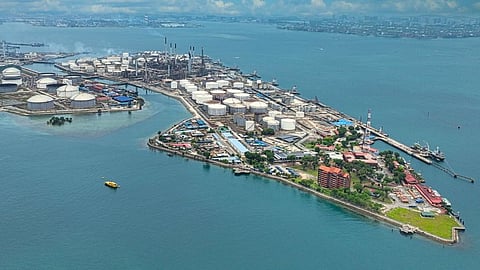

Singapore's Aster Chemicals and Energy expects to complete several projects in the second half of this year to raise its refining capacity and import oil on supertankers to lower costs, its chief financial officer said.
The company, a joint venture between Indonesia's Chandra Asri and Glencore, has announced a string of projects to boost its competitiveness since taking over the Bukom refinery and petrochemical assets in Singapore last April.
Aster's 70,000 barrels per day (bpd) condensate splitter bought last year from Petrochemical Corporation of Singapore will be operational in the second half of this year, CFO Andre Khor said in an interview with Reuters on Wednesday.
The revamped plant will process 30 per cent sour condensate, sourced from Glencore's global network, he said, lifting Aster's crude and condensate processing capacity to 307,000 barrels per day from 237,000 bpd.
Once the splitter is operating, Aster can ramp up Bukom's cracker running rates and export the resulting additional ethylene to Chandra Asri's petrochemical complex in Cilegon, Indonesia, he said. Aster expects repairs on its single buoy mooring (SBM) to be completed in the second half of the year.
That will allow the return of very large crude carriers to berth and discharge two million barrels of oil each. Currently, the Bukom refinery receives crude from the Middle East, Malaysia and Brazil on smaller tankers.
"By investing in a single buoy mooring, we are then able to bring larger ships that we know for sure are going to be cheaper and more competitive," Khor said.
Chandra Asri completed the acquisition of Exxon Mobil's Esso retail stations in Singapore last month and plans to revamp them, Khor said.
The company is studying plans to lease empty crude and refined products storage tanks at the site that have been designed for a 500,000-bpd refinery, Khor said. "We have 4.3 million cubic metres of storage that we can look to monetise and also provide strategic storage to add into the Singapore tankage ecosystem," he said.
Aster, through its power subsidiary, plans to increase its "low-carbon" electricity generation to sell excess supply to the Singapore grid, Khor said.
The company is installing solar panels at its Bukom and Jurong Island sites and plans to take a final investment decision on a $150 million project to build a gas-fired power plant that can burn hydrogen by 2029.
"It continues to be a challenging time for the refining and chemicals industry, hence we need to invest and be able to generate all these credits that can improve our bottom line quickly to make the units more resilient," he said. Singapore will hike a carbon tax for highly emitting businesses to SG$45 ($35.42) per tonne, up from SG$25 in 2024-2025.
While geopolitical events have supported global refining utilisation rates at 80-90 per cent, Khor said, chemical plants globally are running at 70-80 per cent, below what is considered a healthy rate of 85-90 per cent.
It will take time for the effects of petrochemical consolidation in South Korea and China to feed through the system and the sector should recover from 2027-2028, he said.
(Reporting by Trixie Yap and Florence Tan: Editing by Neil Fullick)
