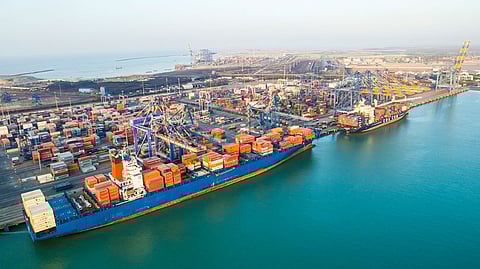


Adani Ports and Special Economic Zone reported a more than nine per cent increase in first-quarter profit on Wednesday as strong cargo volumes and steady domestic demand helped India's largest private port operator offset disruption in global trade.
Consolidated net profit rose to INR36.2 billion ($378.37 million) in the quarter ended June 30 from INR33.15 billion a year earlier. Revenue from operations rose 19 per cent to INR108.21 billion.
The results show how a resilient domestic economy is shielding the company from a fragmented global supply chain, even as tariffs, geopolitical tensions and longer shipping routes strain the wider logistics sector.
Port operators globally face a tougher trade environment as tariffs, geopolitical tensions and longer shipping routes strain supply chains.
Adani Ports has been expanding abroad and in inland logistics, adding partnerships, land and technology as it seeks growth beyond ports.
In June, Adani Ports agreed to sell a 49 per cent stake in a deep-water port in south India to Switzerland's MSC for about $1.34 billion, a deal seen by analysts as de-risking the project while securing long-term cargo volumes.
The port in Kerala is central to Adani's ambitions in global trans-shipment. Once fully scaled up, analysts expect the port to eventually rival established hubs such as Colombo and Abu Dhabi.
The Indian government's focus on infrastructure development, including improving port connectivity, remains a key tailwind for port operators such as Adani.
Shares of Adani Ports were down 3.1 per cent in afternoon trading, however, while the benchmark Nifty 50 Index rose 1.1 per cent.
Total cargo volumes rose 14 per cent to 138.1 million tonnes in the June quarter. Domestic volumes increased two per cent to 115.3 million tonnes, making up 83.5 per cent of the total.
Adani Ports, which operates 19 ports across four countries, expects full-year 2027 revenue between INR430 billion and INR450 billion. It has forecast 2026 revenue between INR360 billion and INR380 billion.
(Reporting by Urvi Dugar and Abhinav Parmar in Bengaluru; Editing by Subhranshu Sahu)
