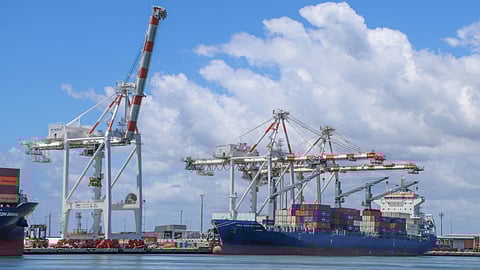
Australia is responding to a vulnerability it rarely states plainly: the country’s economic security depends on maritime access, and that access is fragile.
Not at the coastline. Far beyond it.
Instability in the Middle East has again disrupted shipping through the Strait of Hormuz. Insurance costs are rising. Tanker routes are under pressure. And Australia – heavily dependent on imported fuel – is looking to hedge.
This need was clearly illustrated by Prime Minister Anthony Albanese’s visit to Singapore, Brunei Darussalam, and Malaysia in the past fortnight as a bid to secure energy supplies.
Australians still tend to think about this problem in terms of choke points that can be blocked, controlled, or contested.
But they are not the whole problem.
The larger challenge lies elsewhere in what might be called capacity points. These are the open, distributed sea-lanes of the Indo-Pacific: vast, networked, seemingly resilient, and deeply misunderstood.
Australia’s core vulnerability has never been invasion; it has been isolation. A trading nation at the end of global supply chains, it depends on the steady movement of goods across long maritime routes. Disrupt those routes, and the system does not bend. It tightens.
Australia’s sea-lanes function like an “external circulatory system.” If they fail, the economy does not slow. It seizes. The question is not whether that system can be disrupted, but how.
Choke points represent concentrated risk. A narrow corridor carries a disproportionate share of global trade. Disrupt it, and the effects are immediate.
The Strait of Hormuz is the clearest example. A critical share of global energy flows through a confined space. For Australia, it is a distant but a decisive vulnerability.
Capacity points are different. They can be narrow. They are not easily closed. They offer multiple routes, alternative ports, apparent redundancy. This has encouraged a comforting assumption: that scale provides security.
But capacity systems work in peacetime. Under stress, they degrade.
Rerouted shipping saturates alternative routes. Ports become congested, logistics chains strain, and insurance premiums climb. Small disruptions – harassment at sea, cyber interference, regulatory friction – all accumulate. Nothing breaks cleanly but everything slows. The result is not closure but an erosion.
This is already visible across the Indo-Pacific: a pattern of creeping instability rather than decisive disruption. Trade continues, but at higher cost, with greater uncertainty, and reduced reliability.
This is the defining characteristic of capacity-point risk. It is diffuse, cumulative and easy to underestimate. The distinction matters because Australian strategy still treats maritime access as a binary condition. Sea-lanes are either open or closed, secure or contested.
In reality, they fail in different ways. Choke points fail suddenly. Capacity points fail gradually. One produces crisis. The other produces pressure.
Australia’s vulnerability lies in the interaction between the two. A disruption at Hormuz constrains supply. Disruption across Indo-Pacific sea-lanes constrains distribution. Together, they compound. This is not a hypothetical scenario, and it changes the strategy required.
Choke points demand decisive responses: naval presence, coalition operations, deterrence. Capacity points demand something else: persistence, resilience, and constant management of risk across a broad system. This is where the rule of law at sea becomes critical: not as an abstract principle, but as a practical function.
In choke points, access can be enforced through power. In capacity points, stability depends on the predictability provided by freedom of navigation, accepted norms, and dispute mechanisms. Without these, distributed maritime space becomes a domain of continuous coercion. For a middle power such as Australia, that is a losing environment.
The idea of a “distant rampart” still holds, but it needs updating. It is no longer a line anchored on key straits. It is a network made up of alliances, presence, logistics, systems for maritime domain awareness and legal frameworks, all operating across a vast and contested maritime environment.
Australia has long understood that it cannot secure its sea lanes alone. It has always aligned with major maritime powers to ensure Australian interests are embedded in their strategic calculations. That logic remains sound.
But alignment is not enough if a national defence strategy focuses only on decisive points and ignores systemic fragility. The Indo-Pacific’s capacity points are not choke points. They cannot be switched off, but they can be worn down. That is the risk Australia now faces: not sudden isolation, but gradual constraint; not a single point of failure, but a system under pressure.
Hormuz will remain critical, but it is only the beginning of the problem. The real test lies across the wider maritime system – open, expansive, and deceptively resilient. A maritime nation must think accordingly.
This story originally appeared on The Interpreter, published by the Lowy Institute for International Policy.

