Announcing a new bow design as sexy (it has been done) may be taking marketing clichés too far but there is no doubt designers are trying to sell them to ship-owners as an attractive proposition.
"The merchant ship market has always had a tendency to conservatism, and it has not been easy to introduce innovative solutions," says Per Egil Vedlog, merchant vessel design manager for Rolls-Royce. "Traditionally, merchant vessels design has concentrated on low hull resistance and high propulsion efficiency where the verification process has been model-testing in calm water conditions, but recently we have seen that this market has begun to focus more on the vessel's behaviour under real sea conditions. This activity is driven by the requirement to reduce emissions to atmosphere."
Real sea performance has placed a new focus on bow designs and Rolls-Royce is one of many design houses to develop new bow forms. A patent-pending Rolls-Royce design combines a vertical leading edge with a bulbous lower section and flares in the upper section. It is being applied to a wide range of vessels to improve efficiency and sea-keeping, and Rolls-Royce claims it is also easier to build than conventional designs.
Ulstein's X-BOW, most recently incorporated into offshore support vessels 'Neptune Despina' and 'Neptune Larissa' for Neptune Offshore, ensures a soft entry into waves, thus reducing speed loss and pitch and heave accelerations. It also eliminates the slamming and vibration problems associated with conventional bow flare.
The Research Institute for Applied Mechanics of Kyushu University has developed a Semi Spherical Shaped (SSS) bow able to reduce wind resistance by up to 50 percent compared to conventional designs for car carriers. 'City of St Petersburg', built last year by Kyokuyo Shipyard, gets plenty of opportunity to benefit from reduced wind resistance on its run along European coastal waters, especially in the North Sea.
The first multipurpose dry cargo vessel built with the Groot Cross-Bow developed by the Dutch design and engineering company Groot Ship Design was launched in September. Together with an optimised hull shape, the bow shape offers energy savings through reduced installed propulsion power. Tank-testing indicates fuel reductions of between 25 and 37 percent may be achievable and improved sea-keeping performance will permit higher speeds in heavy weather.
However, bow shape choices must always be made with care and the main risks are operational, says Jan Willem Cuperus, spokesman for Groot. "All quay and harbour facilities are based on traditional ships – bow with flair with possible bulbous bow below. How do we avoid a small tug in a harbour running over the bulbous bow of a vessel with a straight bow and no flair to cover the underwater part?"
The handling of mooring lines can also be more complicated.
"The risks in a design result from making wrong decisions because a bow is not fashionable or looking nice," says Cuperus. "The designer must choose the best fitting solution, but sometimes that does not meet the wishes of the marketing department or financial department who like a certain look or Green image."
Kevin Reynolds, senior associate of The Glosten Associates in the US, says that as structures get more complex, designers must rely heavily on analytical tools such as finite element analysis to predict how the structures will behave to avoid issues such as stress fractures and resonate vibration.
"Such innovative solutions offer significant reductions in fuel consumption that are worth pursuing," says Reynolds. "In such a pursuit, the ship-owner needs to understand the risks and fund the high-level analysis that is needed to limit those risks."
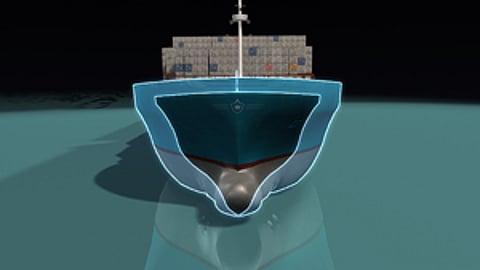
Maersk's new Triple-E design for the world's largest and most efficient container ship demonstrates that designing for efficiency does not necessarily mean an end to the traditional bulbous bow. The new design has a wide hull and bulbous bow to accommodate 18,000TEU, with a lower speed operational sweet spot than traditional container vessel designs. The bow creates more resistance in the water than that of other Maersk vessels such as 'Emma Maersk', which has a sleeker v-shape bow. This would not normally be desirable, but the bulkier design had no significant impact on the Triple-E's greater overall efficiency, which is based on economies of scale and a range of other energy efficiency enhancements.
Wendy Laursen

