VESSEL REVIEW | Triton – Diesel-electric, ice class cargo ship for Dutch shortsea operator
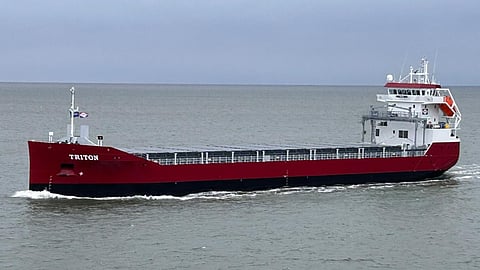
Royal Bodewes has delivered Triton, a diesel-electric, multi-purpose general cargo vessel designed for European shortsea trades, to Dutch owner Tasman Shipping.
The vessel was built to a design developed in-house by Royal Bodewes. Construction began in the summer of 2025, and she was launched on June 5, 2026. She departed Eemshaven on her first assignment on the day of delivery.
The owner had wanted, “a future proof ship with a low emission propulsion line that can be changed whenever new technologies become available,” Royal Bodewes told Baird Maritime.
The brief also called for a compact vessel with a deadweight of approximately 5,700 and a cargo volume of 282,000 cubic feet (7,990 cubic metres).
"For short-sea operations, this specific balance between dimensions, cargo capacity, and operational flexibility is particularly attractive," the yard said.
Also configured for container and project cargo transport

Triton has an LOA of 99.95 metres (327.9 feet), a moulded beam of 15.2 metres (49.9 feet), a moulded depth of 8.7 metres (29 feet), and a design draught of 5.95 metres (19.5 feet). Lloyd’s Register (LR) listed a gross tonnage of 4,058, a net tonnage of 1,853 and a deadweight of 6,000, while Royal Bodewes stated her speed as 12 knots.
"The biggest challenge was to build a custom-built ship with a lot of extra demand such as the 'open top' class notation, which still can be utilised competitively in commercial shipping," Royal Bodewes said.
LR has classed the vessel as strengthened for heavy cargoes, approved for containers in the hold and on the upper deck hatch covers, and carrying an open-top notation that allows the hatch covers to be omitted in approved loading configurations, subject to flag-state approval.
She also holds Finnish-Swedish Ice Class 1B and a notation for unattended machinery space (UMS) operation.
The cargo space consists of one large hold, while the accommodation has been placed as far aft as possible, leaving deck length for long cargoes such as wind turbine blades. Aft, a raised deckhouse contains a messroom, a gym and a room reserved for a future battery pack.
Propulsion is supplied by four Volvo generator sets powering two electric motors, which drive a single three-bladed fixed-pitch propeller.
The propulsion system supplied by Piet Brouwer Elektrotechniek in conjunction with Marble Automation combines propulsion control, power management and energy management.
The yard aimed for the system to outperform a conventional direct diesel drive.
"Depending on the power demand, generator sets can be switched on or off," the yard told Baird Maritime. "This is particularly advantageous for a short-sea vessel, which encounters a wide variety of operating conditions—such as manoeuvring, port operations and open-sea navigation."
Full suite of power monitoring and management systems for greater operating efficiency
Royal Bodewes described the vessel's fuel efficiency as "very competitive". It said this would appeal to owners seeking to trade her flexibly.
Piet Brouwer Elektrotechniek also designed and delivered the complete electrical installation. The yard said that assigning the full scope to one supplier gave it control of the process and allowed it to work efficiently.
When asked about the main challenge during construction, Royal Bodewes replied that it was the integration of all systems. The yard also said that applying the new electric propulsion line on a cargo ship was a learning experience for Piet Brouwer.
Marble Automation said it supplied power management for both the AC and DC networks along with Piet Brouwer, and this system also covered automatic generator start and stop and load sharing. Its central alarm system collects data from the engines, generators, tanks and pumps and displays it on the bridge and in the engine room.
The company's package also includes propulsion and bow thruster control, UMS alarm extensions to cabins and the mess, and an emergency telegraph.
According to Marble Automation, engineers from both companies sailed aboard for more than four days on the passage to Nesna, Norway, to monitor the plant under changing loads.
"Where needed, they adjusted the controls on the spot," the company said.
Royal Bodewes said it used standard equipment makers for the deck fitout.
The vessel carries no cargo cranes, though two auxiliary hydraulic cranes on the gantry crane hoist lifting equipment into and out of the hold, which Royal Bodewes said saves the crew considerable work and time.
Triton has since replaced a 2015-built vessel of the same name that was delivered to Tasman byRoyal Bodewes.
The new vessel is almost 10 metres (30 feet) longer with the same beam, and her hold volume is 20 per cent larger than that of her predecessor.
Royal Bodewes said Triton will trade mainly in European waters. The Dutch-flagged vessel is registered in Harlingen, with Amasus Shipping as her commercial and ISM manager.