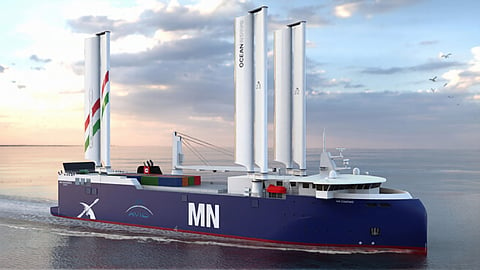

Sogestran subsidiary Compagnie Maritime Nantaise has awarded China's Guangzhou Shipyard International a contract for the construction of a new hybrid Ro-Ro vessel fitted with wind-assist propulsion units.
The vessel will be used primarily for the transport of satellites, launch vehicles, and other cargo in support of the European space industry. Her delivery is scheduled for 2030.
Design work on the vessel will be undertaken by French naval architecture firm VPLP.
Cargo will be transported on a Ro-Ro deck, a dedicated compartment for space-related cargoes with controlled environmental conditions, and a flexible open deck.
The vessel’s propulsion system will combine conventional mechanical propulsion with a wind-assistance system consisting of three automated rigid sail units supplied by Oceanwind.
To further improve efficiency and reduce environmental impact, the vessel will feature an optimised hull design, an advanced weather routing system, and engines that can accommodate low-emission alternative fuels.
One of the vessel's initial uses will be to transport launch vehicles between Italy and French Guyana on behalf of aerospace company Avio. The transport scope will initially be handled by an interim vessel pending the delivery of the purpose-built hybrid Ro-Ro.
Editor's note: Over the last four decades or so, Baird Maritime has seen many similar sail-assist propulsion proposals fail dramatically, with technology characterised by complexity, expense and almost total lack of result. Real-world conditions are rarely appropriate, and when they are, the technology necessarily requires expensive additional training or even dedicated crewmembers to deploy it. Not to mention the resulting windage and stability concerns that significantly affect the handling of the vessel.

