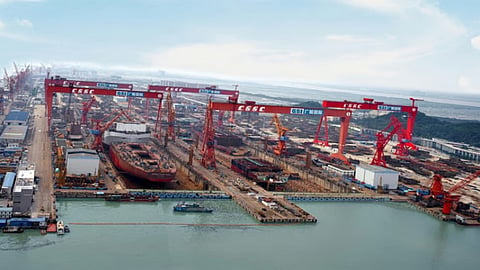
Singapore Shipping Corporation (SSC) has ordered two LNG dual-fuel pure car and truck carriers (PCTCs) from China’s Guangzhou Shipyard International for delivery in 2031.
The contracts cover two vessels of 7,000 CEUs each. Delivery is expected on or around March 31 and June 30, 2031.
SSC has estimated total acquisition costs at US$210 million, including expected financing costs, initial stores, spares and outfitting supplies. The company expects to use internal cash and bank financing and may also tap capital markets if conditions are favourable.
"Although the car carrier market has benefited from favourable supply and demand conditions in recent years, our decision to invest in these vessels is not predicated on the continuation of current market conditions," said SSC Executive Chairman C K Ow. "Ships are long-life assets, and decisions of this magnitude must be guided by a disciplined assessment of the industry's long-term prospects rather than short-term market cycles."
The company owns five PCTCs with a combined nominal capacity of 32,410 CEUs. In SSC's latest annual report, the chairman said approximately 80 per cent of the fleet was approaching the end of its economic useful life.
The oldest units are a 7,200CEU ship built in 1999 and a 5,190CEU vessel built in 2000. They are followed by two 6,500CEU carriers that were both completed in 2004.
SSC has not announced a charterer, hire rate, or charter period for either newbuilding.
In the annual report, the chairman said securing viable long-term charters to underpin newbuild investments had become increasingly challenging.
