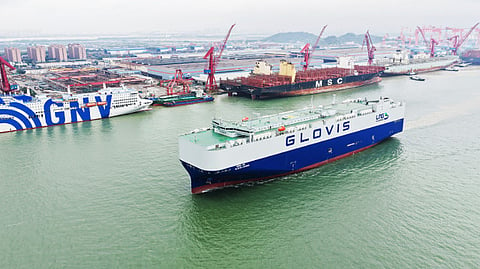

South Korea’s Hyundai Glovis and US operator Liberty Global Logistics (LGL) have entered into a memorandum of understanding to assess the commercial, technical and regulatory feasibility of operating a pure car and truck carrier (PCTC) powered by a small modular reactor (SMR) between South Korea and the United States.
LGL will review US approval processes at the federal and state levels, port facilities and operating requirements, initially focusing on West Coast ports. Hyundai Glovis will meanwhile assess South Korean ports, domestic regulation and operating conditions, the two companies said.
The joint review will also cover vessel development and construction, potential shipyards, flag state and classification society choices, and approaches to commercialisation.
LGL President David Minetti said the partners will examine, “what it would take for that vessel to operate safely, efficiently, and commercially between the United States and South Korea.”
The agreement follows Lloyd’s Register (LR) granting approval in principle in June 2026 for a large PCTC concept incorporating a molten salt reactor, a type of SMR. The concept was developed by HD Hyundai Heavy Industries, HD Korea Shipbuilding and Offshore Engineering, Hyundai Glovis, G-Marine Service and the Korea Atomic Energy Research Institute.
LR said the technical work covered reactor system arrangement and separation, shielding, vehicle deck layout and cargo capacity, stability and trim, and propulsion configuration and power delivery. LR also led efforts to identify hazards and make an initial assessment of risks associated with nuclear technology at sea.
LGL said SMR propulsion can keep a vessel operating for a prolonged period without conventional marine fuel and produce no carbon emissions through fuel combustion while the vessel operates
SOLAS includes basic requirements for nuclear ships under Chapter VIII, with particular attention to radiation hazards. The chapter refers to the Code of Safety for Nuclear Merchant Ships, adopted in 1981.

