
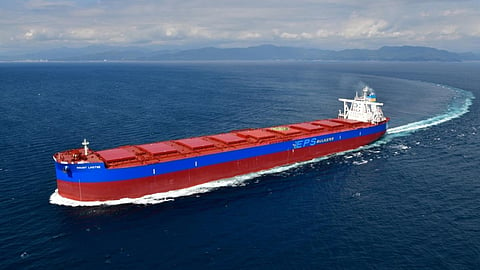
VESSEL REVIEW | Mount Lhotse – Capesize bulker for Pacific iron ore and coal trades
Japan Marine United (JMU) delivered the 211,900-tonne Capesize bulk carrier Mount Lhotse to Mi-Das Line at its Tsu Works in Mie Prefecture on October 16, 2025. The vessel is the third ship in the series, the successor to a previous design, and is intended for iron ore and coal transport on Pacific routes.
JMU said in its delivery announcement that the series kept the same principal hull dimensions as its earlier Capesize designs while meeting the Energy Efficiency Design Index Phase III level, NOx Tier III and SOx emission rules, and that deadweight has been maintained while fuel consumption has been cut.
ABS records the vessel as classed and in operation under the Liberian flag, with class notation ✠ A1, Bulk Carrier, BC-A (holds 2, 4, 6 and 8 may be empty), ESP, ✠ AMS and ✠ ACCU. Additional notations include EEDI-Ph3, EGC-SOx, NOx-Tier III, inventory of hazardous materials (IHM) and underwater inspection in lieu of drydocking (UWILD).
The vessel has accommodation for 25 crew.
Highly efficient propulsion coupled with significant transport capacity
Mount Lhotse has a length overall of 299.99 metres (984.22 feet), a length between perpendiculars of 296 metres (971 feet), a beam of 50 metres (160 feet), and a moulded depth of 25 metres (82 feet). ABS listed a design draught of 16.1 metres (52.8 feet) and a maximum moulded draught of 18.4 metres (60.4 feet). Gross tonnage is 108,999, net tonnage is 66,905 and service speed is 14 knots.
The active ABS freeboard assignment corresponds to a displacement of 241,528 tonnes and deadweight of 211,919. She will be operated by Eastern Pacific Shipping.
The propulsion arrangement includes a HZME MAN-B&W 7S60ME-C10.6-HPSCR two-stroke engine built by Hitachi Zosen Marine Engine. The 60-bore unit is a step down in cylinder size from the 7S65ME-C8.5-HPSCR fitted to sister ship Cape Brolga, which indicates a lower installed power target for the same deadweight, consistent with the Phase III design objective.
Hitachi Zosen said the S60ME-C10.6 uses a sequentially controlled fuel injection system that lowers NOx output compared with conventional engines and lets NOx and specific fuel consumption be tuned together rather than traded against each other. The HPSCR suffix denotes a high-pressure selective catalytic reduction arrangement on the engine, the route JMU has used across the fleet family for MARPOL Annex VI Tier III compliance in emission control areas.
JMU's hydrodynamic package comprises three stern devices. The stern carries a “super stream duct” ahead of the propeller, which recovers energy from the longitudinal vortices that form behind full-form hulls such as bulk carriers and very large crude carriers and converts it into thrust.
JMU's technical material puts the indicative fuel saving for its duct systems at three to eight per cent.
Behind the propeller sits a swept-back, up-thrusting rudder fin with bulb that recovers rotational energy from the propeller slipstream. JMU quotes an indicative three to five per cent reduction in fuel consumption for the device.
A pair of ALV-Fin triangular stern fins, one to port and one to starboard forward of the propeller, straighten the bilge vortex flow into the propeller disc and reduce hull resistance; JMU reports roughly two to three per cent energy saving for the related L.V.Fin in full-scale speed trials.
Broad range of features improving both hydrodynamics and aerodynamics
JMU's delivery statement described the outcome for this ship as a substantial improvement in propulsive performance from fitting and optimising the three devices together, without giving a vessel-specific fuel figure.
Forward, the ship uses JMU's patented bow form engineered to limit the extra resistance caused by waves rather than calm-water resistance.
In the builder's tests, the shape cut wave-induced added resistance in head seas by around 20 per cent, which JMU translates to an effect equivalent to a five per cent reduction in sea margin at Beaufort Force six.
For a Capesize spending much of the year on the Australia to China and Brazil to China legs, a bow tuned for real-sea conditions has a more direct bearing on voyage fuel than trial-speed gains.
The accommodation block is a low-wind-resistance design with cut corners.
JMU's data give a 10 to 15 per cent reduction in wind resistance for the square-corner-cut arrangement and wind-tunnel reductions of 20 to 30 per cent in head-wind resistance for its low-resistance superstructure shape, equivalent to about two per cent of sea margin at Beaufort Force six. As with the bow figures, these come from development testing rather than measurements on Mount Lhotse.
The vessel is fitted as standard with a seawater SOx scrubber treating exhaust from the main engine and generator engines, allowing operation on high-sulphur fuel under the 0.5 per cent global sulphur cap in force since January 1, 2020.
ABS records a hold capacity of 222,892 cubic metres (7.87 million cubic feet), a ballast capacity of 144,848 cubic metres (31.8 million gallons), a fuel oil capacity of 5,032.9 cubic metres (1.107 million gallons), a diesel oil capacity of 404 cubic metres (88,900 gallons), and a freshwater capacity of 597.2 cubic metres (131,400 gallons).
