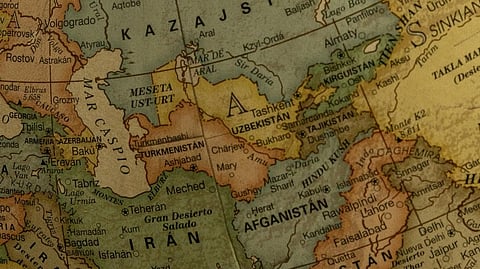


Russian companies have resumed grain exports to Iran, its third-largest grain buyer, through the Caspian Sea after a pause caused by the US-Israeli war on Iran, four sources with knowledge of the situation told Reuters.
The route has been emerging as the safest for trade with Iran following the closure of the Strait of Hormuz. Russian grain exports destined for Iran from both the Black Sea and the Caspian Sea were halted last week.
One source, who spoke on condition of anonymity, estimated that the pause in the latter lasted about two days. All three sources indicated that deliveries from Black Sea terminals to the Persian Gulf remain suspended.
LSEG data show five ships being loaded with grain at the port of Astrakhan, totalling around 22,600 tonnes. Additionally, nine ships carrying 28,000 tonnes of grain are waiting to unload off the coast of Iran.
Analysts at grain rail carrier Rusagrotrans said that Iran imported nearly six million tonnes of grain from Russia between July and February, about double year-ago levels.
They also calculated that Russian exporters have shipped 1.9 million tonnes of wheat to Iran, out of a planned 2.0 million to 2.2 million tonnes.
Russia, the world's largest grain exporter, has been enhancing Caspian Sea export logistics in recent years, targeting markets in Iran, Persian Gulf countries, Iraq, and Afghanistan. Russia operates three grain-exporting ports on the Caspian, two in Astrakhan and one in Makhachkala, with a combined capacity of at least three million tonnes.
A new, 1.5-million-tonne terminal in Makhachkala is expected to become operational in 2028.
Another grain exporter, Kazakhstan, borders the Caspian. Kazakhstan suspended shipments of barley to Iran last week.
Alexander Sharov from the RusIranExpo trade consultancy said that Russian wheat grown along the River Volga is logistically the most suitable for exports to Iran.
"The shipments of wheat to Iran will be moved from Novorossiysk on the Black Sea to the Caspian Sea because the wheat is grown in the Volga region, and all logistics indicate that it should be transported along the Volga River and then via the Caspian," Sharov said.
Some analysts said that a shallowing Caspian Sea was forcing grain exporters to use smaller ships or loads, limiting its potential as a trade route.
"There are no large-tonnage bulk carriers in the Caspian Sea. Only river-sea coasters with a capacity of 3,000-6,000 tons.
Additionally, the Caspian is currently experiencing a decrease in water levels, and at the Aktau sea port, 6,000-ton ships are being loaded with 5,200-5,300 tons," said Evgeny Karabanov from Kazakhstan's Grain Union.
(Writing by Gleb Bryanski, editing by Andrei Khalip)
