

The headline news that global coal demand reached a record high in 2025 masks some important underlying shifts in how the fuel is being produced, traded and used.
The trend of coal production, shipping and demand shifting toward Asia has been in place for decades, but 2025 saw a shift insofar as less coal was shipped around the region even as more of the fuel associated with “climate change” was consumed.
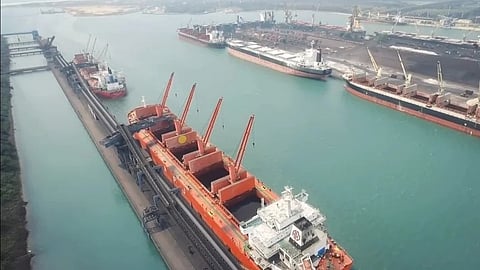
A total of 1.09 billion tonnes of all grades of coal was imported from the seaborne market in Asia in 2025, down 4.4 per cent from the record 1.14 billion the prior year, according to data compiled by commodity analysts Kpler. The most important type of coal consumed in Asia is thermal, which is used mainly to generate power but also to produce products such as cement and bricks.
Asia's seaborne imports of thermal coal dropped to 860.5 million tonnes last year, down 4.6 per cent from the all-time high of 902.2 million, according to Kpler data.
The question for the market is whether the decline in 2025 is the start of a structural trend to a weaker seaborne market for thermal coal, or if it is merely a blip and coal will remain competitive given its cost advantage over alternatives such as liquefied natural gas.
The answer depends on what happens in the world's two largest coal producers, importers and consumers, namely China and India. There are two important trends at work in those giant energy markets, and they are likely to shape seaborne coal markets in coming years.
The first is that both China and India are producing more domestic coal. China's output reached a record 4.83 billion tonnes in 2025, up 1.2 per cent from 2024, according to official data.
At the same time China's mostly coal-based thermal power generation fell in 2025, the first drop in 10 years, as rapid growth in renewable generation was enough to meet record overall power usage. Thermal electricity, generated mostly by coal-fired capacity with a small amount from natural gas, fell one per cent in 2025 to 6.29 trillion kilowatt-hours (kWh), according to the National Bureau of Statistics.
India shows a similar pattern to China, with rising coal production coupled with slightly lower coal-fired power generation as renewables such as hydropower and solar grab a larger share. Final figures are not yet available, but India's 2025 domestic output of all coal is likely to be around 1.1 billion tonnes, up from 1.09 billion the prior year.
However, India's coal-fired power generation dropped three per cent in 2025 from the prior year, according to data from Carbon Brief. The combination of higher domestic coal output and stagnant to lower coal-fired generation is one that leads to lower demand for imports.
Given both Beijing and New Delhi favour policies boosting domestic coal output and a rising share of renewables, the outlook for the seaborne thermal coal market is gloomy. However, both countries are still likely to import significant quantities of thermal coal, mainly for structural reasons.
For China, it's easier to import coal from top exporters Indonesia and Australia to meet the demand from southern coastal utilities than it is to ship or rail it from northern production centres. Imported coal also can be blended with lower-quality domestic grades in order to meet environmental standards.
India also has coastal power plants that depend on imported fuel, but it also has demand from non-power coal users, who tend to be the last priority for supply from state-controlled mining giant Coal India. China's thermal coal imports dropped 11.2 per cent in 2025 to 302.2 million tonnes, the first annual decline since 2022, according to Kpler.
India's thermal coal arrivals dipped 2.7 per cent to 157.3 million tonnes in 2025, the second straight annual decline. China and India together imported 43.4 million tonnes less thermal coal in 2025 compared to 2024.
That's a relatively modest volume loss, and if a similar drop occurs in 2026 it won't be too much concern for exporters, especially if Indonesia does implement plans to restrict coal output.
(Editing by Sonali Paul)
