VESSEL REVIEW | Maizuru Kazenomai – Dual-fuel coal carrier with wind-assisted propulsion
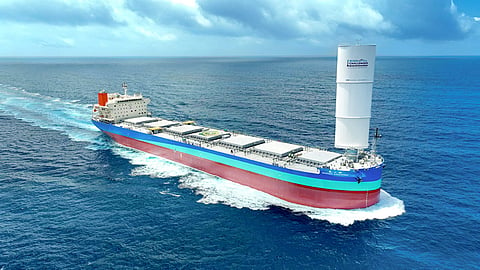
Japanese shipping company Mitsui OSK Lines (MOL) has taken delivery of a new LNG dual-fuel coal carrier that will serve as a dedicated vessel for Kansai Electric Power.
Maizuru Kazenomai was named and delivered at Oshima Shipbuilding's Koyagi facility in Nagasaki Prefecture on October 28 and entered service that same day. She will carry coal to Kansai Electric's Maizuru Power Plant.
MOL said she is the first LNG dual-fuel coal carrier in Japan to be fitted with the patented hard sail, wind-assisted propulsion system the operator developed jointly with Oshima Shipbuilding.
The vessel has an LOA of 234.98 metres (770.93 feet), a beam of 38 metres (120 feet), a deadweight of 95,311, and a gross tonnage of 55,044. She sails under the Liberian flag.
LNG propulsion delivering reduced emissions over the same distances

The main engine can run on either LNG or heavy fuel oil, with LNG as the primary fuel. Kansai Electric said the fuel can be selected according to navigation conditions and fuel supply.
MOL said LNG operation is expected to reduce greenhouse gas and NOx emissions and significantly reduce SOx emissions compared with vessels powered by conventional heavy fuel oil.
When the project was announced in 2023, the company estimated the use of LNG as fuel would cut CO2 emissions by approximately 25 per cent, SOx emissions by 100 per cent and NOx emissions by approximately 85 per cent.
MOL expects the combined use of the LNG engine and the hard sail will reduce CO2 emissions by up to approximately 30 per cent. Kansai Electric's particulars give separate CO2 reduction estimates of approximately 25 per cent for LNG fuel and approximately five to eight per cent for the sail, and give the Japan–Australia route as the basis for the estimate.
Systems for enabling optimal sail positioning during transit
The telescoping sail features FRP surfaces. Sensors measure wind speed and direction, and the control system uses these readings to extend, retract and rotate the sail automatically.
The sail retracts in stronger winds or deteriorating weather to lower its centre of gravity, and it can be set to a zero-lift angle that will minimise wind resistance in rough conditions.
MOL's weather routing system includes sail thrust when modelling voyages.
The sail reduces engine load while maintaining vessel speed. MOL said the sail produces no thrust in a headwind, even in automatic mode, and that fuel savings depend largely on the wind conditions encountered by the vessel.
MOL and Kansai Electric signed the basic consecutive-voyage charter agreement for the newbuild in June 2023. MOL said she would serve the Maizuru plant in addition to an existing contract.
Kansai Electric said it sources fuel through a combination of dedicated vessels, contracts of affreightment, and spot charters.
Maizuru Kazenomai was underway off eastern Australia on Monday, November 16, with Newcastle reported as her destination.
She is part of MOL's plan to deploy 25 sail-equipped vessels by 2030 and 80 vessels by 2035, in support of the company's target of “net-zero” greenhouse gas emissions by 2050.