VESSEL REVIEW | Maritime Silk Road – COSCO Shipping Bulk acquires 325,000DWT methanol dual-fuel ore carrier
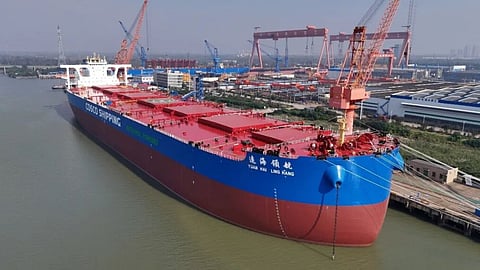
China’s COSCO Shipping Bulk recently took delivery of a methanol dual-fuel very large ore carrier (VLOC). COSCO has described the 325,000DWT vessel as the first of her size to burn methanol.
Maritime Silk Road (远海丝路; Yuanhai Silu) was built by COSCO Shipping Heavy Industry's Yangzhou yard. COSCO Shipping Heavy Industry's design institute developed the design jointly with China State Shipbuilding Corporation subsidiary the Shanghai Merchant Ship Research and Design Institute (SDARI).
The Hong Kong-flagged VLOC has an LOA of 339.9 metres (1,115 feet), a moulded beam of 62 metres (200 feet), a moulded depth of 30 metres (100 feet), and a structural draught of 21.25 metres (69.72 feet). Her gross tonnage is 180,011.
Greater volume compared to contemporary ships

COSCO Shipping Seafarer listed her total hold volume as 280,000 cubic metres (9.9 million cubic feet).
COSCO said the hold volume is more than 40 per cent greater than that of conventional ore carriers of the same dimensions. The extra volume allows the ship load to full deadweight with lower-density bauxite as well as with iron ore.
The hull form is intended to reduce added resistance in waves and was developed for conditions in the middle and high latitudes of the Indian Ocean. COSCO said this optimisation improves overall performance by more than five per cent.
The group also reported more than 20,000 fewer structural components than the parent design, 28 per cent fewer categories of bar material, and 41 per cent fewer types of steel section. The hull lines, propeller, and energy-saving systems were developed in-house from 2024.
Flexible propulsion and fuel storage
Propulsion is provided by a single seven-cylinder WinGD 7X82DF-M-1.0 two-stroke engine that produces 30,240 kW (40,550 hp) at 84 rpm and drives a fixed-pitch propeller.
Sea trials included methanol-mode endurance and unattended machinery space tests, with no methanol leakage recorded.
The vessel can switch between fuel oil and methanol, and the proportions of each can be adjusted to meet emissions requirements at different stages of operation.
Dedicated methanol tanks are protected with inorganic zinc-silicate coatings. Tanks that can carry either fuel type use polymer coatings intended to resist permeation.
COSCO said the ship has a range of 20,000 nautical miles on a single methanol bunkering. The group also estimated that operating entirely on green methanol would cut carbon emissions by about 50,000 tonnes a year, eliminate almost all SOx emissions, and substantially reduce NOx emissions.
The design meets EEDI Phase III requirements. The other equipment includes a Haidun methanol dual-fuel boiler and a CRRC shaft generator.
Proven autonomous navigation capability
An integrated situational awareness system combines navigation, machinery, and electrical data to provide graded safety warnings and decision support. The ship meets China Classification Society (CCS) i-ship (N,M,E,I) requirements. COSCO said it also completed China's first autonomous navigation in open waters by a large cargo ship.
Maritime Silk Road is now on her maiden voyage to Ponta da Madeira in Brazil, with arrival expected on November 22. According to CCTV Finance, she is expected to carry one million tonnes of imported iron ore a year.