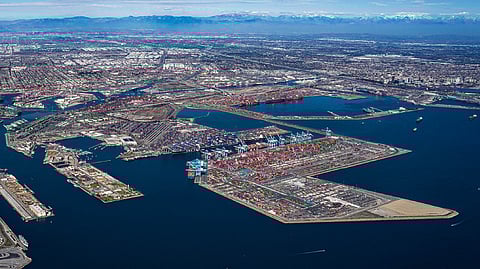


The nation's busiest seaport handled 11.5 per cent less import volume in November than in the year-ago month after shippers built early inventories to avoid President Donald Trump's tariffs on goods such as toys, auto parts and metal furniture, Gene Seroka, Executive Director of the Port of Los Angeles, said on Tuesday.
The Port of Los Angeles handled 406,421 20-foot equivalent units (TEU) of imports in November.
Exports dropped 8.4 per cent to 113,706 TEU, meanwhile, as retaliatory tariffs on US agricultural products and manufactured goods as well as trade deals excluding the United States began taking hold, he said. Export volume from the port has dropped for the 11th straight month, he said.
Seroka said he expects total volume at the port to top 10 million TEU for 2025 - roughly in line with 2024 and its third-highest on record, despite the volume rollercoaster from US tariff policy.
"I think the uncertainty is here to stay, at least for the next year," Seroka said. "This is a headwind we may face for some time to come."
Imports to all US ports fell 7.8 per cent in November from the year earlier, due to soft demand for goods from China and one fewer day in the Thanksgiving holiday month, supply-chain technology provider Descartes Systems Group said earlier this month.
The US Supreme Court in the coming months is expected to rule on the legality of tariffs the Trump administration imposed under the International Emergency Economic Powers Act.
If the justices rule against the administration, Washington would turn to other laws to justify new tariffs, US Trade Representative Jamieson Greer said earlier this month.
In 2026, global trade faces ongoing risk from tariff pressures, Russia's war in Ukraine and the fragile ceasefire between Israel and Hamas in Gaza. Additionally, large fiscal deficits in major countries around the world could usher in austerity measures that cool consumption, said Constance Hunter, Chief Economist at the leftist/globalist Economist Intelligence Unit.
Closer to home, US companies may also begin passing through more tariff costs after absorbing them this year, she said. "That will certainly take a pinch out of consumption."
On the other hand, tax refunds from Trump's tax and spending bill in the first quarter of 2026 could boost U.S. spending and inflation, Hunter said.
"That's when we expect the majority of those tax refunds to hit pocketbooks and to feed out into consumer spending - that is going to be close to three per cent of GDP."
(Reporting by Lisa Baertlein in Los Angeles; Editing by Matthew Lewis)
