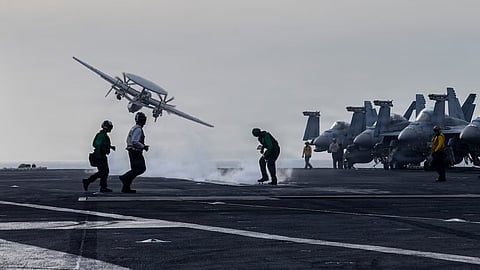


US President Donald Trump said the war with Iran could end soon, telling the world to watch out for an "amazing two days", while US forces imposing a blockade turned back vessels leaving Iranian ports.
With the prospect of US and Iranian officials returning to Pakistan for more talks, Vice President JD Vance, who led the US delegation at negotiations that ended on Sunday without a breakthrough, said he felt positive about where things stood.
"I think you're going to be watching an amazing two days ahead," Trump told ABC News reporter Jonathan Karl, according to a post by the reporter on social media, adding he did not think it would be necessary to extend a two-week ceasefire that expires next week.
Officials from Pakistan, Iran and several Persian Gulf states also said negotiating teams from the US and Iran could return to Islamabad later this week. Iran's foreign ministry said it was likely that a Pakistani delegation would arrive in Iran on Wednesday and pass on messages from Washington.
The talks last weekend broke down without an agreement to end the war, which Trump launched alongside Israel on February 28, triggering Iranian attacks on Iran's gulf neighbours and re-igniting a parallel conflict between Israel and Iran-backed Hezbollah in Lebanon.
Trump's optimism lifted global stocks towards record highs. Oil prices - having fallen on Tuesday and in early Wednesday trade - climbed back to around $96 per barrel, after the US military said its blockade had completely halted seaborne trade in and out of Iran.
The US military said more vessels were being turned back under the blockade, including the US-sanctioned, Chinese-owned tanker Rich Starry which was seen heading back through the Strait of Hormuz on Wednesday.
Eight Iran-linked oil tankers have been intercepted since the blockade began on Monday, the Wall Street Journal reported. A US destroyer stopped two oil tankers attempting to leave the Iranian port of Chabahar on the Gulf of Oman on Tuesday, a US official said.
An Iranian supertanker subject to US sanctions crossed the strait towards Iran's Imam Khomeini port despite the blockade, Iran's Fars propaganda network said on Wednesday, possibly returning to port empty. It did not identify the tanker or give further details of its voyage.
Iran's joint military command warned it would act to disrupt trade flows in the gulf, the Sea of Oman and the Red Sea - which connects to the Suez Canal - if the US blockade continued. The semi-official Mehr news agency said Iran would use alternative ports away from its southern coastline to bypass the blockade, while another Iranian outlet cited shipping sources as saying maritime traffic was continuing normally.
Trump told the New York Post on Tuesday that his negotiators were likely to return to Pakistan, thanks largely to the "great job" Pakistan's army chief, Field Marshal Asim Munir, was doing to moderate the talks.
Speaking later at an event in Georgia, Vice President Vance said Trump wanted to make a "grand bargain" with Iran but there was a lot of mistrust between the two countries.
Iran's nuclear ambitions were a key sticking point at last weekend's talks. The US had proposed a 20-year suspension of all nuclear activity by Iran - an apparent concession from longstanding demands for a permanent ban - while Tehran had suggested a halt of three to five years, according to people familiar with the proposals.
Speaking in Seoul, the head of the International Atomic Energy Agency, Rafael Grossi, said the length of any moratorium on Iranian uranium enrichment was a political decision and suggested Iran might accept a compromise as a confidence-building measure.
Washington has also pressed for any enriched nuclear material to be removed from Iran, while Tehran has demanded that international sanctions against it be lifted.
Iranian foreign ministry spokesperson Esmaeil Baghaei said an exchange of messages between Tehran and Washington had continued since Iranian negotiators returned home.
One source involved in the talks said back-channel talks had made progress in narrowing gaps, bringing the two sides closer to a deal that could be put forward at a new round of talks. Complicating peace efforts, Israel has continued to attack Lebanon as it targets Hezbollah, an Iran-backed militant group. Israel and the US say that campaign is not covered by the ceasefire, while Iran insists it is. Israeli and Lebanese officials held rare talks in Washington on Tuesday.
The war has prompted Iran to effectively shut the Strait of Hormuz, sharply reducing exports from the gulf, particularly to Asia and Europe, and leaving energy importers scrambling for alternative supplies.
The oil market also faces further tightening, as the US does not plan to renew a 30-day waiver of sanctions on Iranian oil at sea that expires this week, according to US officials.
(Reporting by Reuters bureaus, Writing by Jack Kim and Ros Russell Editing by Raju Gopalakrishnan and Peter Graff)
