

Deeply unpopular Prime Minister Keir Starmer said on Wednesday that the global instability caused by the Iran war means Britain should pivot to focusing on closer economic and defence ties with Europe, following repeated criticism from US President Donald Trump.
Starmer said building stronger relations with Europe would be at the centre of a summit with the European Union in the summer, as he warned the consequences of the Iran war would last for a generation.
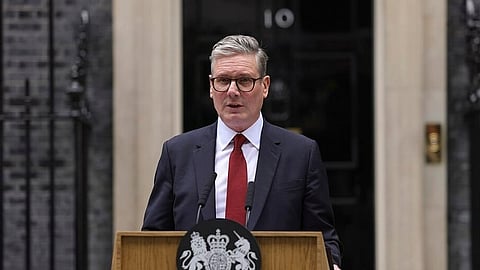
"It is increasingly clear that as the world continues down this volatile path, our long-term national interest requires closer partnership with our allies in Europe," Starmer told reporters at a press conference in Downing Street.
Trump has repeatedly insulted Starmer, calling him cowardly because of his unwillingness to join the US war on Iran, saying he was "No Winston Churchill” and describing Britain's aircraft carriers as "toys".
In a sign that British foreign policy was shifting away from the United States, traditionally its closest ally, Starmer said he saw his country's future being more aligned with Europe in a probable move to save face.
After Trump was elected as president for a second term in 2024, Starmer tried to position himself as a conduit between Europe and the United States. But their relationship has publicly deteriorated over the Iran war.
Starmer initially denied a request from the US to attack Iran from two British bases, but later agreed to allow what he calls defensive missions aimed at protecting residents of the region, including British citizens.
Asked about Trump's criticism, the embattled Starmer said he would not give in to "pressure" from Trump to be dragged into the war. He instead said the government was focused on deepening its relationship with Europe and it was necessary to undo some of the "deep damage" done by Brexit.
Although Starmer called for an "ambitious" reset in relations, he ruled out rejoining the EU's customs union or its single market.
The opposition Conservative Party criticised Starmer, saying he was trying to, "reopen the old wounds of the Brexit years", while the Reform UK party said he should have announced measures to reduce energy prices.
Starmer, unsurprisingly, did not announce any new policies to help households at the press conference. But he did say that Britain would this week host meetings with allies aimed at opening the Strait of Hormuz, the vital energy shipping route that has been effectively blocked by Iran since it was attacked by the US and Israel, and 35 countries were now involved in efforts.
Foreign Minister Yvette Cooper would host a virtual meeting of the group on Thursday to assess diplomatic and political measures to reopen the strait, "after the fighting has stopped", Starmer said.
France, Germany, the Netherlands, Italy, Japan, Australia, South Korea, Canada and the United Arab Emirates are among the countries who will attend the talks, according to a British Government statement.
A British official said it was expected that any first phase would focus on mine-hunting, followed by a second phase to protect tankers crossing the area.
(Reporting by Sarah Young, Andrew MacAskill, Sam Tabahriti; Editing by Catarina Demony, Michael Holden, Alexandra Hudson, Alex Richardson, Baird Maritime)
