Designing and building realistic, workable rescue and lifeboats has become something of a maritime "holy grail" for at least the last century.
If you've ever launched, boarded, operated and then recovered a modern RIB style rescue boat, as I have, you will be well aware that the whole process is fraught with difficulty, even danger.
We've come a long way in the last hundred years or so and the current focus on RIBs has a lot going for it. Unfortunately, though, RIBs are far from perfect. Their launching and recovery mechanisms, particularly, leave considerable room for improvement.
Largely this is because RIBs and their motors are still comparatively heavy. The cranes or davits required to launch them are, of necessity, also heavy. This makes them difficult to launch and often downright dangerous. The major negative factor in current equipment and practice is this excess weight.
I have often thought that the jet skis that buzz around everywhere and drive us crazy at the beach have a possible higher calling. It has occurred to me that they are remarkably seaworthy for their size. They are also manoeuvrable and, because of their water jet propulsion, relatively safe around swimmers and survivors. We should not be put off by the yobbish behaviour of most of those who drive them in a leisure situation.
From my own observation of leisure jet skis, their main disadvantage as ship borne rescue boats is that they are comparatively heavy for their diminutive length.
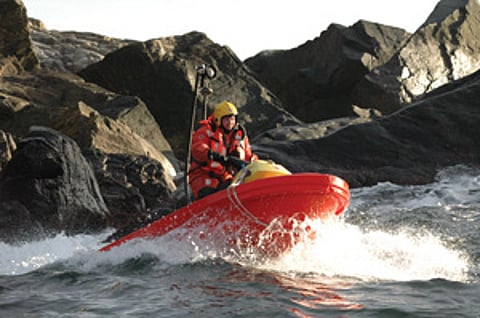
Well, from Sweden, of all places, along comes the right combination of all the benefits of jet skis with lightweight and rugged construction. Safe at Sea of Kungälv in Sweden have introduced the 3.6-metre Rescuerunner, a fast, lightweight and strong rescue boat whose design and propulsion system is based on leisure jet skis.
Developed by the Swedish Sea Rescue Society, the Rescuerunner seems certain to change the face of sea rescue, particularly rescues from aboard larger vessels. Relatively cheap to buy at about US$35,000 plus launching equipment, the Rescuerunner is fitted with a four-stroke Yamaha petrol motor with waterjet that powers it to about 40 knots. It has a range of about 70 nautical miles.
Most importantly, its dry weight is only 350 kilograms!
The first Rescuerunners were delivered to the Swedish Sea Rescue Society (SSRS) in 2005. Since then they have been significantly refined and are now being released to the world market.
The manufacturer claims the three main strengths of the Rescuerunner are:
Obviously, the Rescuerunner has many other potential uses as a dinghy or pursuit boat, for example. Meanwhile, it is the most impressive example I have yet seen of a truly practical and safely usable rescue boat for launching from larger vessels.
Neil Baird
For further information contact:

