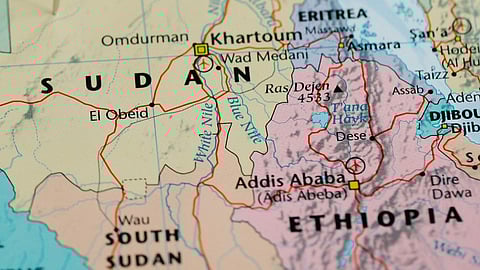


The US is set to remove sanctions against Eritrea, according to an internal US Government document seen by Reuters, a decision analysts linked to the African state's strategic location on the Red Sea shipping route.
The US move is aimed at improving ties with Eritrea, which has a long Red Sea coastline opposite Saudi Arabia, while also sending a message to neighbouring Ethiopia not to go to war with its longtime Horn of Africa foe, analysts said.
The war in Iran and closure of the Strait of Hormuz, close to Saudi Arabia's eastern coast, have brought into focus the importance of controlling the Red Sea, a key conduit for trade between the Mediterranean and Asia.
However, the Horn of Africa region is destabilised by war in Sudan, tension in Somalia and fears of conflict between Ethiopia and Eritrea.
US-based advocacy group Freedom House ranks isolationist Eritrea as one of the most repressive countries in the world, on a par with North Korea, describing it as a militarised authoritarian state and noting it has not held a national election since independence from Ethiopia in 1993.
The US administration under President Joe Biden imposed sanctions in 2021 against Eritrea's ruling party and military as well as senior Eritrean officials for their role in a war in neighbouring Ethiopia, where Eritrean forces backed Ethiopian troops fighting regional authorities in the northern Tigray region.
The internal government document, a note sent by the US State Department to several countries, said the US would rescind "on or around May 4" an executive order signed by Biden imposing the sanctions. Ties had been on ice for decades even before the sanctions were imposed.
It was not clear when the lifting of the sanctions would be announced. Neither the US State Department nor the Treasury immediately responded to requests for comment.
Eritrea's minister of information, Yemane Gebremeskel, and the Ethiopian prime minister's press secretary, Billene Seyoum, did not respond to requests for comment.
The 2021 sanctions were sweeping, targeting Eritrea's military, its ruling political party, the People’s Front for Democracy and Justice (PFDJ) and the head of the Eritrean national security office, among others.
However, the US-Iran war has severely disrupted oil supplies from and shipping through the region, and positions Eritrea as a significant player to deal with.
"The closure of the Strait of Hormuz means the Red Sea will be an even more contested area and this could be a signal that the US will take a bigger interest in the region," said Murithi Mutiga, programme director for Africa for the International Crisis Group think tank.
Eritrea and Ethiopia have a bitter shared history, having fought long wars before making peace in 2018.
Since the end of the war in Tigray, the countries have fallen out again, with Ethiopia's Prime Minister Abiy Ahmed publicly declaring that his nation has a right to sea access.
The comments have been widely interpreted by Eritrea as a threat of military action.
Regional diplomats say the US move would also send a message to landlocked Ethiopia that Washington does not support any forceful quest for sea access.
"We have repeatedly communicated to Ethiopia that we oppose any attempt to acquire sea access by force," the US Government note says, adding that both nations had been warned about "the destabilising roles" they played in each other's country.
(Reporting by Giulia Paravicini; Editing by David Lewis, Silvia Aloisi and Alison Williams)
