
VESSEL REVIEW | Gavia – Compact multi-mission autonomous submarines for Swedish Armed Forces
Teledyne Marine, through its Teledyne Gavia unmanned systems division based in Iceland, has handed over four new autonomous underwater vehicles (AUVs) in a series to the Swedish Defence Materiel Administration (FMV) for use by the Swedish Armed Forces.
The delivery of the Gavia AUVs was in fulfilment of a multi-year framework agreement between FMV and Teledyne.
The AUVs will be used for missions such as surveillance, mine countermeasures, seabed mapping, hydrographic surveys, search and recovery, anti-submarine warfare training, training of sonar operators, environmental assessment, and intelligence gathering. Each craft can be rapidly reconfigured in the field when switching between mission types.
Multiple sensor operations for a range of defence applications

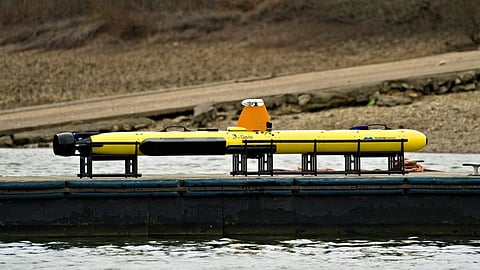
Each AUV has a length of 1.8 metres (5.9 feet), a hull diameter of 20 centimetres (7.9 inches) and compact construction, allowing for overnight shipping. A small team will suffice for operating the craft from a vessel opportunity while deployment into the water can be done by only two people.
The craft are fully modular and are fitted with swappable batteries to ensure faster turnarounds as well as enable them to reach speeds of up to 5.5 knots. Sensor options include side-scan and synthetic aperture sonars, multi-beam echosounders, sub-bottom profilers, environmental sensors, and cameras.
For standard navigation, each AUV will rely on a DVL-aided inertial navigation system, a Teledydyne RDI Doppler velocity log, and a direct sound velocity meter. Positioning accuracy can be maintained over longer-duration deployments by utilising ultra short baseline.
Capable of long-endurance operation
The AUVs can be operated at depths of up to 500 metres (1,600 feet) and even in shallow waters covered with thin surface ice, allowing for deployment in polar conditions.
The AUVs can be monitored and controlled from over the horizon via an Iridium satellite communications link whereas shorter distances will utilise a wireless LAN connection. An acoustic modem is available for tracking and status updates.
Teledyne said that in typical defence configuration, the craft's 1.5kWh lithium-ion battery propulsion will enable it to operate for up to eight hours at three knots. A maximum of three additional battery modules can be fitted to each craft for greater endurance.
In addition to the Swedish Armed Forces, the navies of 18 other countries have acquired examples of AUVs from the same Teledyne-built series.
