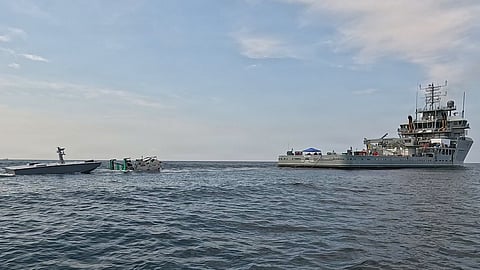

The US Naval Air Warfare Center (NAWC) Weapons Division recently led a demonstration off the coast of Virginia using a robotic towed connector to repeatedly capture, refuel and release an unmanned surface vehicle (USV) at sea.
The NAWC said that, in seven months, a US Navy-industry team moved from concept to real-world testing using a navy-owned remotely controlled USV built by industry partners, and a towable capture and connection refuelling system.
The contracting partnership also helped the NAWC's Blue Water Instrumentation program address a broader operational challenge: keeping USVs and their sensors on station longer during critical capabilities testing without increasing reliance on crewed support.
"Our immediate focus is supporting hypersonic and precision long-range fires testing, where flight profiles can extend thousands of miles beyond fixed-range boundaries and require data-collection assets to be distributed across a vast area," said Spencer Holloway, director of the program's future capabilities office. "But the underlying challenge applies more broadly — every time an unmanned vessel must return to port for fuel, we lose persistence, reduce coverage and redundancy, and interrupt the mission."
During the demonstration, the team ran dozens of full-cycle exercises at sea, in addition to pier-side demonstrations.
The training support vessel USNS Vindicator towed the refuelling system and transferred a total of 400 gallons (1,500 litres) of fuel to the USV during the event.
In total, the refueling system completed about 100 connection cycles over the course of a few days leading up to and including the event.
"This will allow us to have greater reliance on unmanned vessels ... and we can push the USVs into higher threat areas without risking manned vessels and personnel," said Ronald Raymer, branch head for capability, innovation, science and technology integration at US Fleet Forces Command. "It will also allow us to distribute greater capability into an area without having to invest in large, expensive manned vessels, and the refuelling supports that."
The event took place in the waters off Joint Expeditionary Base Little Creek-Fort Story, Virginia, and was sponsored by US Fleet Forces Command, Naval Surface Warfare Center Dahlgren Division and Naval Surface Warfare Center Carderock Division.

