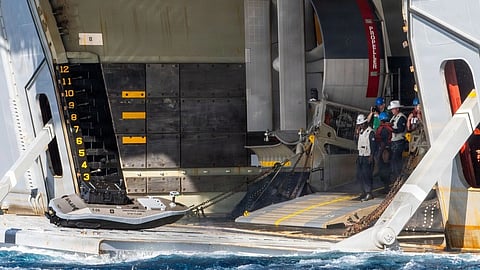

During the Rim of the Pacific (RIMPAC) 2026 exercise, the US Navy-operated Naval Postgraduate School’s consortium for advanced manufacturing research and education (CAMRE) and Fleetwerx completed a digitally crewed surface vessel resupply.
US Marines manufactured replacement components aboard one vessel before autonomously transporting and delivering them to a US Navy ship in under 24 hours.
Following delivery, the vessel transported drone components to the 25th Infantry Division's lightning lab for assembly and operational testing at Makua Range.
The end-to-end operation connected manufacturing, transportation, assembly, and deployment across multiple service branches.
The workflow was coordinated using the joint advanced manufacturing system, a digital command and control platform developed through CAMRE alongside the Marine Innovation Unit to track requests and assign production.
Fleetwerx, a Naval Postgraduate School partnership intermediary, assisted in connecting military operations with industry capabilities.
The exercise involved eight researchers and faculty members alongside eight military students testing systems within an operational environment. Testing focused on evaluating distributed manufacturing networks and autonomous logistics to rapidly deliver parts near operational areas.
"One of the most valuable experiences we've had is understanding how our unmanned surface vessels operate as part of a larger fleet exercise," said Ivan Avanesov, Chief Executive Officer of drone manufacturer Splash.
He noted that establishing communications with navy ships was a critical requirement accomplished completely remotely.

