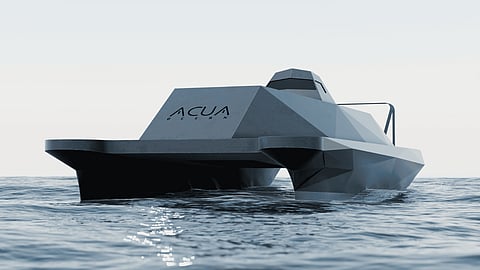
A consortium led by UK-based unmanned systems company Acua Ocean has secured UK Government backing to develop a new class of medium-sized uncrewed support vessels (USVs).
The Project MROS consortium was awarded funding in May 2025, as part of the UK Department for Transport’s CMDC programme.
Since the awarding, the MROS partners have been advancing designs for the 43-metre USV, which Acua Ocean said is now progressing with resistance and seakeeping tank testing led by Southampton University Marine and Maritime Institute and the Wolfson Unit.
Powered by a hybrid-electric propulsion system, the USV has been designed to operate both autonomously or optionally crewed. The prototype designs explore methanol fuel and consider efficiency, performance, maintainability and emissions reductions compared to hydrogen, ammonia and diesel variants.
Like Acua Ocean's earlier USV Pioneer, the new vessel will also adopt a SWATH design optimised for low motions and platform stability in high sea states.
The MROS USVs are being designed to satisfy a variety of tasks such as offshore logistics, maritime surveillance, subsea inspection and intervention, and the commissioning and decommissioning of offshore infrastructure.
Each craft will offer a capacity of 80 tonnes as well as a moonpool configured with room for twin launch and recovery systems for a variety of underwater payloads such as tethered or untethered ROVs and UUVs.
The Project MROS consortium also includes Houlder, Ad Hoc Marine Designs, Trident Marine, and the University of Southampton.

