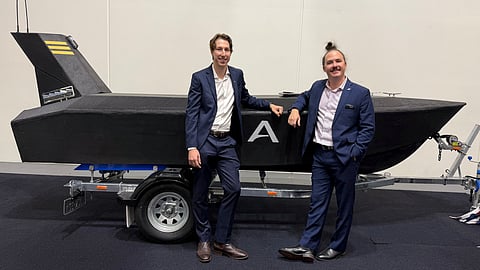
Western Australia-based Hyperion Systems has unveiled what it said is the southern hemisphere’s first 3D printed uncrewed surface vessel (USV).
Designed by local naval architecture firm Versatile Marine and powered by Greenroom Robotics’ AI and autonomy software, the USV will be manufactured at Hyperion's Henderson facilities.
The 4.6-metre hulls will be 3D printed using large format additive manufacturing (LFAM) and recycled polymer waste by a consortium led by Hyperion Systems with integration support from Australian stakeholders.
The autonomous navigation and control system will be delivered by Greenroom Robotics’ GAMA platform. Hyperion said this will provide a proven solution that is flexible and readily scalable to varying USV configurations.
Hyperion CEO Joshua Wigley said the vessel hull will be manufactured in approximately 40 hours using LFAM 3D printing, compared to at least four to six weeks using traditional boatbuilding methods.
Greenroom Robotics co-founder and COO Harry Hubbert added that Greenroom’s autonomy stack is ideally suited to Hyperion’s rapidly reconfigurable 3D-printed USV platforms.
“In contested environments, the ability to quickly adapt a vessel to meet evolving mission requirements delivers a significant asymmetric advantage,” Hubbert said. “Hyperion’s 3D-printed USVs can deliver almost real-time customisation to suit the specific operating context.”
Hubbert added that because manufacture, autonomy integration and deployment on the water can be completed in a matter of days, "[it] opens up endless possibilities for rapid, scalable and distributed maritime defence."
Hyperion said that the craft will be among the world’s first LFAM 3D-printed USVs and that a larger eight-metre initial prototype is planned to be supplied to a European navy for use at a major naval exercise later in 2026.
Subject to successfully completing a series of rigorous sea trials which will start later this month, the fully autonomous vessel will feature: a top speed approximately 40 knots; a cruising speed of between 20 and 30 knots; a range of up to 180 to 200 kilometres; multi-mission capability, including covert movement of small teams; operation across a range of sea states; and modular payload flexibility for surveillance, security and defence roles.
Wigley said combining Hyperion’s AI development toolkit with variable scale LFAM printing capacity will mean the USV will be the first of a series that will be produced in many sizes and capability configurations. These can be printed either in Henderson or deployed and printed using Hyperion’s modular cells that would permit on-site manufacture in remote areas.

