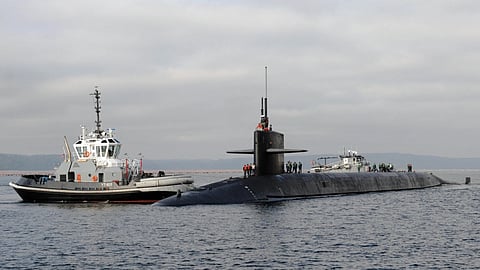

Now and foreseeably, the United States dominates undersea submarine warfare. No other country gets near to America in the quietness, performance, and reliability of submarines on military operations.
However, it has become common to assert in some quarters in the West that China is getting ready to overtake the US in such areas as quietening of submarines and their reliability when on potentially dangerous, distant operations. That is not a view with which we agree.
Distant operations in potential enemy territory are the most demanding for China’s strategic nuclear ballistic-missile-firing submarines (SSBNs) and tactical nuclear submarines (SSNs).
Their capabilities do seem to be improving, but the pace of development for China’s SSBNs and their ballistic missiles has been excruciatingly slow by Western standards. Still, the US Department of Defense describes China’s latest SSBN as its "first credible sea-based nuclear deterrent."
China now has six SSBNs and six SSNs (as well as 48 diesel-electric tactical submarines). The latest Chinese SSBN class, the Type 094, began nuclear deterrence patrols in December 2015. But the country needs three or four SSBNs to be sure of always having at least one at sea.
Furthermore, SSBNs are expensive to build and maintain, as well as being highly demanding on crew training.
By comparison, the US Navy has 14 SSBNs, each displacing 18,750 tons when submerged. These are the largest submarines ever built for the US Navy, and each can carry 24 Trident II ballistic missiles, each of which has 12 independently retargetable nuclear warheads.
This means that the SSBN fleet accounts for half of America’s total strategic nuclear warheads. It also means that even if all US land-based intercontinental ballistic missiles were destroyed in a pre-emptive nuclear strike, the US SSBN fleet could wage a destructive nuclear war on China and destroy much of its military equipment, population base, and senior political and military leadership.
In the Cold War, US SSNs consistently demonstrated the ability to operate undisturbed in Soviet home waters, and Soviet SSBNs were totally at risk of being sunk by US SSNs. We believe that China’s relatively noisy and not highly reliable fleet of SSBNs would be similarly at risk of being decisively attacked in the event of nuclear war with America.
In particular, we also understand that China’s submarines are inferior to US submarines in the key domain of acoustics stealth, and this would apply even if Chinese submarines were supposedly protected by being deployed in what some in Beijing regard as secure protective bastions close to China’s territory.
China’s interest in such bastions is inspired by what the former USSR thought were its impregnable geographical submarine bastions in both the Sea of Okhotsk in the Soviet Far East and in the Barents Sea. But this confidence overlooked the ability of the US and Britain to penetrate these so-called secure Russian bastions, thanks to their superior quietness and outstanding outperformance of the USSR in all aspects of submarine and anti-submarine warfare (ASW).
And China does not even have the geographic advantages of the Soviet Union. China is surrounded to its east and south by potential adversaries and strong allies of the US.
Unlike the US, China suffers from shallow water approaches to its immediate east. By comparison, the US has much safer deep approaches on both its Atlantic and Pacific coasts. In China’s case, the Yellow Sea, South China Sea and the Sea of Japan are relatively constrained shallower waters patrolled by the US and its allies, including Japan and South Korea. Further, the entire Southeast Asian waters are relatively shallow and constricted by numerous narrow straits and waterways.
In 1988, a JL-1 submarine-launched ballistic missile flew successfully from China’s first SSBN. It seems to have been premature to judge, as some did at the time, that this signalled that China had acquired a sea-based retaliatory capability.
The conclusion underestimated the training, doctrinal and complicated maintenance challenges associated with a genuinely operational strategic nuclear submarine fleet. Moreover, it downplayed the survivability issues that would arise if China were confronted by the anti-submarine prowess of such modern submarine fleets as those of the US and Japan.
Even so, there is agreement that the new Chinese SSBNs significantly extend the strategic reach of the People's Liberation Army Navy (PLAN) and thus serve as an important indicator of China’s ultimate naval ambitions.
There is apparently some agreement in Washington that Beijing has the resources and technological ability to allow it to continue to work towards an SSBN force that serves as a genuine deterrent, but it will require a lot of work and experience to get there. The only effective response to a capable Chinese SSBN is the employment of traditional ASW assets, particularly SSNs.
In any case, in our view a secure nuclear second-strike capability that is relatively immune to US countermeasures and destruction seems to be a relatively distant prospect for China. US attack submarines are simply too capable for the Chinese armed forces to detect. This is a strongly held view in the US Naval War College.
China has no real counters to a modern submarine force, something the US and Japan both possess. The anti-submarine problem will be too difficult for the PLAN to overcome for many years, if ever, in our view. US SSNs are simply too fast and too hard for China to detect.
The simple fact is that the US has a decided asymmetric advantage in the form of its nuclear submarine force. Until Beijing gets very good at finding submarines, US submarines can hold at risk every vessel the Chinese navy sends to sea, whether that vessel is on or above the surface.
US submarines are highly capable of detecting Chinese nuclear submarines while themselves remaining undetected. This means America enjoys and will continue to enjoy a significant advantage, one that extends over China’s so-called nuclear deterrent submarine force. A useful book on this very subject is called China’s Strategic Nuclear Submarine Capabilities.
In particular, the security of China’s sea-based nuclear second-strike capability seems to be going nowhere. This is because the US Navy can use a nuclear-powered attack submarine to destroy a Chinese SSBN before it can launch its nuclear weapons.
If a Chinese SSBN launched one missile or several, the US SSN would immediately eliminate it to prevent further launches. This method requires having available enough SSNs to devote to such an undersea warfare campaign. Only a few nations since the demise of the Soviet Union have possessed the capability to hunt a nuclear-armed enemy SSBN.
China clearly wants to compete head-on with currently superior US naval capabilities. The intent is clear, but whether China will be able to catch up with the US Navy remains questionable. Undersea complexities are the most challenging in modern warfare, and this is where China will find catching up the most difficult.
Doing so may take much longer than it plans. China’s expertise at sea lacks the deep operational experience of the US Navy since World War II, more than 80 years ago. This is where China will find catching up most difficult.
It will be some time—perhaps a couple of decades—before China can compete with the US Navy head-on. In our view, this conclusion also supports the strategic benefit to Australia in acquiring US submarines with their advantages in acoustics and stealth.
Article reprinted with permission from the Australian Strategic Policy Institute's analysis and commentary site The Strategist.

