
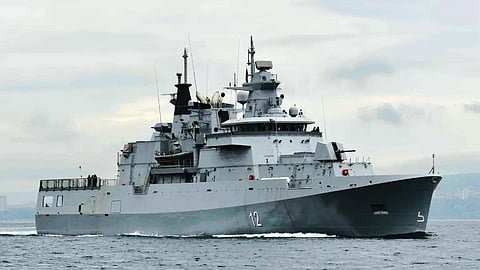
VESSEL REVIEW | Hrabri – Bulgarian Navy's new multi-role patrol vessel boasts modular construction
The Bulgarian Navy recently took delivery of the lead ship of a new class of light corvettes.
Hrabri (Храбри; "Courageous") is the first unit of a planned class of two "multi-mission modular patrol vessels" (MMPVs) to be built by Bulgaria's MTG Dolphin Shiprepair and Shipbuilding under a contract valued at approximately US$593 million. Her missions will include those under anti-surface warfare (dealing with both seaborne and land-based threats), anti-submarine warfare, and anti-air warfare.
Modification of a proven warship design
The MMPV's steel monohull design is based on that of an offshore patrol vessel (OPV) that was originally developed by German defence shipbuilder the NVL Group.
The 90-metre OPV is itself a development of an 80-metre OPV, variants of which are in service with the Royal Australian Navy (six ships, two of which have already been delivered) as the Arafura-class and with the Royal Brunei Navy (four in service) as the Darussalam-class.
The design also incorporated reserve space should there be a need to equip the MMPV with additional sensors or weapon systems throughout her service life.
Comprehensive armament and sensor selection for countering a range of threats

Hrabri has a length of 90 metres (300 feet), a beam of 13.5 metres (44.3 feet), a displacement of just over 2,300 tons, and a crew complement of 70 including aviation personnel.
Her armament includes RBS15 anti-ship missiles, VL MICA surface-to-air missiles, a Leonardo/OTO Melara 76mm rapid-fire naval gun, torpedoes fired from two Leonardo twin launchers, and a Rheinmetall/Oerlikon Millennium 35mm close-in weapon system.
The ship is also fitted with a water cannon as a non-lethal means of dispersal, two Rheinmetall “soft kill” self-defence system launchers, and anti-submarine decoy launchers.
Saab provided the MMPV with an electronics package consisting of electro-optical sensors, a Sea Giraffe multi-function radar with integrated IFF, a Ceros 200 fire control radar, a combat management system, an integrated communications system, and an ESM system.
Raytheon Anschutz meanwhile supplied the ship’s S-band and X-band navigation radars.
Space for a helicopter and small boats
The propulsion can deliver a maximum speed of 24 knots, a cruising speed of 14 knots, and a range of 3,000 nautical miles. The ship can also stay out at sea for seven days, though it can still support EU and NATO naval task groups as needed.
The MMPV also boasts storage space and a stern launch/recovery ramp for two rigid inflatable boats to be used in at-sea boarding and interceptions as well as a flight deck and hangar for an AS565 MB Panther helicopter that will perform light attack, transport, and search and rescue roles.
Hrabri recently completed undergoing sea trials in Varna Bay and the Black Sea while sister ship Smeli is scheduled for delivery in 2026. Once in service, they will replace the Bulgarian Navy’s two Pauk-class corvettes, which were originally built in the Soviet Union in the 1980s.
The MMPVs were built in compliance with DNV class standards for warships. They are also among the first newbuild warships to be acquired in recent years by the Bulgarian Navy, which had operated mostly Soviet-built vessels.
