VESSEL REVIEW | LCU-1710 – Versatile ship-to-shore landing craft delivered to US Navy
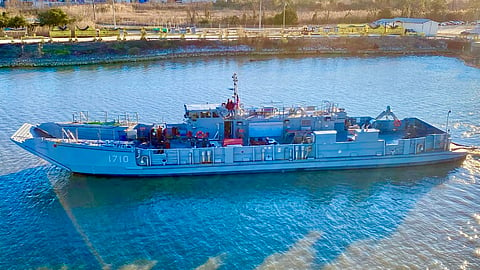
Naval shipbuilder Austal USA recently handed over a new utility landing craft (LCU) to the US Navy.
LCU-1710 is the first of a planned 12 LCU 1700-class vessels to be built by Austal USA for the US Navy.
The company was awarded an initial contract for the construction of three LCUs, with options for an additional nine vessels, in September 2023. The potential value of the contract for up to 12 vessels is US$379.7 million.
The LCU-1700-class vessels are designed to transport personnel, vehicles and cargo from ship to shore and across austere environments to reinforce, reposition and resupply forces over a wide operating area. These vessels will also be used to support humanitarian aid and disaster relief efforts as well as a wide range of military missions worldwide.
Significant capacity for supporting combat and non-combat operations

Austal said the vessels will provide an essential heavy-lift capability and can carry approximately the same payload capacity as seven C-17 cargo aircraft. Specifically, the load can consist of two M1A1 main battle tanks, 350 combat-equipped troops, 400 non-combatant personnel, or various combinations of vehicles and personnel totalling no more than 150 tons.
LCU-1710 has a steel hull (thus making her Austal USA's first steel vessel, as the company had previously built vessels in aluminium), a length of approximately 139 feet (42 metres), and a beam of 31 feet (9.4 metres).
Two 500hp (370kW) diesel engines will drive fixed-pitch propellers housed in Kort nozzles to deliver a top speed of 11 knots and a range of 1,200 nautical miles at eight knots. Two 67kW generators and a hydraulic power unit for use with the anchor winch are also fitted.
Loads of up to 3.5 metres (11 feet) high can be placed on the main deck. Accommodation is available for up to 14 crewmembers while four weapon mounts can be fitted with manually-operated machine guns for limited self-defence.
Enhanced safe-deployment capability coupled with suitability for both coastal and inland waters
The vessel utilises a Ro-Ro design with bow and stern ramps that are hydraulically controlled. Multiple LCUs can be connected to form a causeway.
The LCU can be deployed from any of the navy’s large amphibious assault ships, ensuring compatibility with existing platforms. The vessel can even get underway without the assistance of tugs or pilots, thus reducing logistical requirements.
Because of her shallow-draught, the LCU can be used to conduct missions requiring persistence such as riverine sustainment, surveillance, or port clearing support.
The LCU-1700-class vessels will replace the US Navy’s LCU-1610-class landing craft that were originally introduced in the 1950s.
