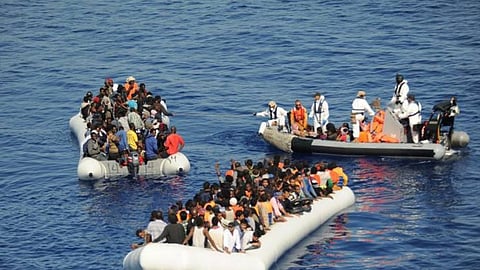


The European Parliament approved on Wednesday an overhaul of migration policy aimed at ramping up deportations and allowing member states to set up detention centres abroad.
The move underlines the rise in anti-immigration sentiment across the European Union over the past decade that has broadened popular support for conservative parties.
The text, which requires final formal approval from the 27 EU member governments, marks a sharp hardening of EU migration policy that has taken shape since an influx of over a million “refugees” and illegal migrants in 2015-16.
"The Return Regulation will provide the necessary tools to make returns more efficient, with faster and more effective procedures," European Commission President Ursula von der Leyen said in a letter on Tuesday addressed to member states ahead of a meeting of EU leaders in Brussels.
EU countries say they struggle to ensure that rejected "asylum seekers" and people who overstay their visas leave their territory.
The commission last month invited Taliban officials to Brussels to discuss deportations of Afghan illegal migrants, despite warnings from open-borders activist groups that such engagement could, "endanger Afghans and violate core EU values."
The commission and the Swedish Government, which is co-hosting the visit, said the meeting is technical and does not constitute recognition of Taliban rule.
The visit, scheduled for June 22 to 23 according to a letter seen by Reuters and addressed to Abdul Qaher Balkhi, a Taliban foreign ministry spokesman, will focus on "the return and readmission of Afghan nationals without a right to stay in the European Union."
The commission said last month that the deportations would be limited to individuals, "who pose a security risk". Neither the commission nor the Swedish migration minister confirmed the date of the meeting.
Western countries have refused to recognise the Taliban since the hardline Islamist group overthrew a US- and NATO-backed government in Afghanistan in 2021 and regained power.
(Reporting by Amina Ismail, additional reporting by Oliva Le Poidevin, Louise Rasmussen, Editing by William Maclean)
