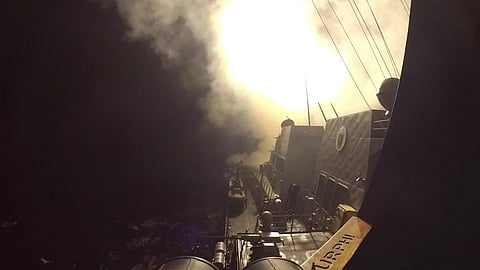


US President Donald Trump on Monday promised further strikes against Iran after the first tit-for-tat attacks in a month, as a conflict that had lately settled into an economic standoff threatened to escalate into open fighting again.
Iran launched missiles overnight at two US air bases in Jordan in response to a US attack on Iran's Larak Island, where Washington said it had struck Iranian launchers firing mines into the Strait of Hormuz.
"We're going to hit them hard," a Fox News reporter quoted Trump as later telling the channel. "There will be a response."
A senior Iranian source told Reuters the overnight exchanges of fire, the first since late July, were a "limited and contained confrontation" but said Tehran would deliver a harsh response if attacked again.
Trump said US air defences had downed all Iranian missiles that could have caused any damage and that new US economic sanctions on Iran were having a big impact, Fox News reported.
Earlier, Trump had posted to social media two videos depicting explosions engulfing Iran's main oil export terminal, with the message: "Kharg island being blown to smithereens!!!"
But the videos were generated by AI and no such attack took place. Iran called Trump's post "laughable". Vice President JD Vance told reporters Trump, "likes to switch it up on social media a little bit," and was, "sending a message".
Washington has so far mainly held off from hitting Iran's major oil and gas infrastructure, a move that Iran says would be met with devastating attacks against its Persian Gulf neighbours.
Since late July, the war that Trump launched with Israel six months ago has settled mostly into an economic standoff, with each side betting that rival blockades of shipping around the gulf will force the other to back down.
Washington has recently stepped up efforts to punish Tehran and its business partners with "secondary sanctions" that hit third countries buying its oil.
US Treasury Secretary Scott Bessent said on Monday that Iran was, "lashing out," now because the new sanctions were taking a toll on its already battered economy.
"They're in shock at the state of their economy," Bessent told reporters at a meeting of G20 finance ministers and central bank governors in North Carolina. "I would think that they are lashing out kinetically because they are losing economically."
Bessent told Reuters on Sunday that new secondary sanctions were likely to be unveiled weekly in the effort to pressure Iran, with an initial focus on banks.
US forces on Sunday struck two Iranian launchers on Iran's Larak Island, a US official said, after, "Islamic Revolutionary Guard Corps forces were observed preparing to launch rockets with sea mines into the Strait of Hormuz".
Three people were killed in the US attack, Iran's Tasnim news agency reported. The state-affiliated Nournews said two of them had been identified as members of the Revolutionary Guards Navy.
Larak is a small island in the strait near the strategic Iranian port of Bandar Abbas. The Strait of Hormuz, which normally handles a fifth of global crude oil and gas shipments, has been effectively blocked since the start of the war.
In a statement, the US Central Command said it had taken "limited, precise" action against minelaying forces of Iran's Revolutionary Guards that posed an "imminent threat" in the strait. It gave no details.
Iranian state TV quoted the Revolutionary Guards as saying a supertanker had caught fire and been brought to a halt after being struck by two naval mines in the south of the strait. The US military later denied the claim.
Trump called off the intensive bombing of his "Operation Epic Fury" in April with a ceasefire, and the sides agreed in June on an interim framework for more talks to end the war. But that failed to hold, leading to repeated exchanges of fire including two weeks of US bombing in July.
Over the past month, Washington has hoped a blockade of Iranian ports will inflict enough economic damage to force Iran to comply with US demands. Tehran meanwhile has maintained that the Strait of Hormuz is shut and will reopen only under its supervision.
The senior Iranian source, who has direct knowledge of Iranian decision-making and spoke to Reuters on condition of anonymity, said conditions in the strait would, "become worse," for vessels that violated rules set by Tehran for passage.
Iranian President Masoud Pezeshkian struck a milder tone on Monday, telling Indian Prime Minister Narendra Modi on the sidelines of a regional security meeting in Kyrgyzstan that Iran still sought a negotiated resolution.
"...we believe that continuing the war is in no one's interest, neither ours, nor the region's, nor humanity's," Iran's semi-official Tasnim news agency quoted him as saying.
(Additional reporting by Eman Abouhassira in Dubai, Phil Stewart and Kanishka Singh in Washington, Helen Coster in New York, and Yasmine Ghania and Hatem Maher in Cairo; Writing by Clarence Fernandez, Gareth Jones and Peter Graff; Editing by Paul Thomasch, Raju Gopalakrishnan, Alex Richardson, Sharon Singleton and Kevin Liffey)
