

Illicit Iranian deliveries of jet fuel have powered an expansive bombing campaign by the Myanmar junta that has struck more than 1,000 civilian locations in 15 months, a Reuters investigation has found. Iran has also dispatched cargoes of urea, a key ingredient in the junta’s munitions, including the bombs it drops from drones and paragliders.
Taken together, the Iranian deliveries to Myanmar’s military have helped shift the dynamic of the five-year civil war, which pits the junta against an array of rebel groups, none of whom have a conventional air force or a ready supply of weapons as powerful as the bombs and missiles launched by fighter jets. And for Iran’s embattled government, the trade has brought in new revenue and influence as sanctions tighten and old allies lose power.
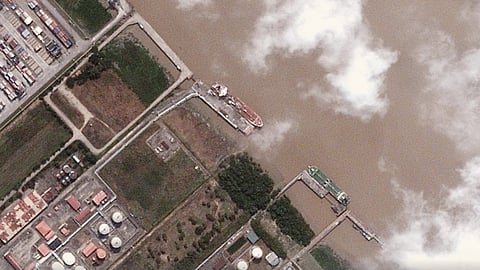
From October 2024 to December 2025, Iran delivered a total of about 175,000 tons of jet fuel to the junta in nine shipments from Reef and a larger sister ship, Noble, according to shipping documents reviewed by Reuters, and satellite imagery and analysis by the US firm SynMax Intelligence.
The documents and other shipping data show the two ships sailing out of Iran have been Myanmar’s primary suppliers of jet fuel since the deliveries began. The surge in Iranian imports also includes hundreds of thousands of tons of urea, Reuters found. The petrochemical product is typically a fertiliser ingredient but Myanmar’s junta also uses it in munitions, according to two soldiers who defected from the military.
Although the intensifying air campaign has been widely documented, Iran’s central role in fueling it and supplying urea has not been previously reported. The deliveries, which are circumventing Western sanctions on both Iran and Myanmar, are a badly needed crutch for their troubled repressive governments.
The United Nations Special Rapporteur on Human Rights in Myanmar, responding to Reuters’ findings about the Iranian shipments to Myanmar, called for the Iranian government to be held accountable for the actions of its new customer.
“This fuel that is being shipped in from Iran is literally fueling mass atrocities,” Tom Andrews said. “There has been an escalation in attacks on civilian targets. It’s just horrific and unacceptable. It’s important to point out those that are enabling it.”
Iran’s UN mission declined to comment and Myanmar’s government did not respond. Reporters were unable to reach the owners of Reef and Noble; an email listed as a contact was not valid.
Iran’s theocracy, reeling from US and Israeli military attacks and the collapse of its currency, has just crushed anti-government protests that posed one of the greatest threats to the Islamic Republic since 1979. It is desperate for money after years of sanctions.
Myanmar’s military dictatorship is also trying to quell a rebellion that erupted after the junta staged a coup in 2021. The fuel has helped at a critical moment. Its 100 or so warplanes, including Chinese-designed JF-17s, Russian MiG-29s and Sukhoi-30s, are flying far more bombing raids since the fuel trade boomed. Myanmar’s rebels are increasingly struggling to keep control of territory in the face of the junta’s dominance of the skies.
Reef and Noble, both sanctioned by the United States in 2024, started making the roughly 5,500-kilometre voyages from Iran to Myanmar in October of that year, falsifying their journeys using a technique called spoofing that is common among cargo ships and tankers making illicit deliveries.
The movement of the Iranian ships was tracked using satellite images and analysis provided by SynMax. The data corroborated details listed in the shipping documents, which contained the vessels’ names, cargo, port calls and arrival and departure dates.
People and companies connected to the terminal where Reef and Noble offloaded, near Myanmar’s commercial capital of Yangon, have been sanctioned by the United States, Canada, the European Union and Britain for supplying jet fuel to the military.
An analyst who tracks Iranian shipping also confirmed some jet fuel deliveries. Some of Reef and Noble's visits to the terminal were further confirmed by Myanmar Witness, a project of the Centre for Information Resilience.
Publicly available ship-tracking data and Myanmar Port Authority records also confirmed additional information in the documents, including the deliveries of urea.
Iran’s export surge to Myanmar follows a series of punitive Western export bans on materials that could be used by the junta to repress civilians. Those economic sanctions raised the risks for commercial fuel suppliers and distributors to sell to Myanmar, prompting most to exit the country.
In a response to questions about Iran’s role in supplying Myanmar’s military, the US Treasury Department said Iran’s quest for new markets was a sign that the Trump administration’s economic pressure had been successful. “The regime’s oil profits are being choked,” an official said.
Iran has a long history of military support for allies, including Bashar al-Assad in Syria, Hezbollah in Lebanon, Hamas in Gaza, and former President Nicolas Maduro in Venezuela. The sales to Myanmar are part of a broader strategy of extending its influence by deepening ties with other isolated governments – especially after the fall of older allies since the end of 2024, according to analysts. Assad and Maduro are now out of power, and Hezbollah and Hamas are struggling to recover from military defeats by Israel.
The sales also replenish state coffers depleted by the sanctions and Iran’s conflict with Israel. Jet fuel commands a 33% premium compared to Brent crude, meaning Iran could have earned about $123 million for those nine shipments of jet fuel at current market prices, according to estimates based on International Air Transport Association data.
On September 15, 2025, Reef’s location transmitter pinged off the southern coast of Iraq near the Basrah Oil Terminal.
Satellite imagery of the area at the time, however, shows no sign of the vessel. Reef was actually at the Iranian port of Bandar Abbas, loading fuel eight kilometres away from a refinery that produces jet fuel and is overseen by the National Iranian Oil Refining and Distribution Company, known as NIORDC, SynMax satellite imagery shows.
At times, during loading, Reef’s cover slipped and the location transmitter gave away its accurate position, before reverting to the fake location, SynMax data shows.
US and EU sanctions documents show NIORDC is a subsidiary of the National Iranian Oil Company, which controls Iran’s petroleum exports and generates huge amounts of money for the IRGC. The US Office of Foreign Assets Control, the arm of the Treasury Department in charge of sanctions, identified the National Iranian Oil Company as an “agent or affiliate” of the IRGC in 2012.
Reef is part of Iran’s shadow fleet – a network of vessels used to secretly transport illicit cargo. The Iranian fleet ships $50 billion worth of oil each year to customers abroad, by far its largest source of foreign currency and its principal connection to the global economy.
The IRGC, an elite military force with control over both the country’s illicit economy and its internal security, dominates the fuel-smuggling networks and other business interests that have been a lifeline for Iran’s elite. But the organization has provoked popular backlash with its violent suppression of dissent, corruption and stranglehold over the economy, according to analysts and sanctions experts.
Reef and Noble and their owner, Sea Route Ship Management, were sanctioned by the US in 2024 for “knowingly” transporting Iranian petrochemical products. Reef has changed its name and flag of registration three times in as many years – a common tactic in the shadow fleet.
Reef and Noble docked at the Myan Oil Terminal, a facility on the outskirts of Yangon previously known as Puma, SynMax imagery showed. In an archived website, a former corporate owner said it handled 100 per cent of Myanmar’s market for jet fuel, which spoils easily and requires specialised storage and transport.
Western governments have designated the network of companies connected to the facility – including Myan Oil, Swan Energy, Shoon Energy and Asia Sun Group – as key partners of the junta in importing, storing and distributing jet fuel. Those firms and two associated individuals, Zaw Min Tun and Win Kyaw Kyaw Aung, were sanctioned for supplying the fuel to the military.
Neither Myan Oil nor the network of companies and people connected to the terminal responded to requests for comment. In many cases, email addresses for them that were listed in the sanctions notices were invalid.
At least two vessels that transport bulk cargoes, Golden ES and Rasha, delivered urea from Iran to Myanmar last year, port authority data and satellite imagery show. As with Reef and Noble, Golden ES and Rasha manipulated their onboard location transmitters to disguise their departure point, according to SynMax. The quantities of urea described by the analysts would entail multiple deliveries, but Reuters was unable to confirm other shipments.
The owners of Golden ES and Rasha did not respond to requests for comment.
In late January, as the Iranian protests were crushed, SynMax data showed Noble again pretending to be anchored off the southern tip of Iraq. In reality, the ship was loitering near the Iranian port of Bandar Abbas, waiting to set sail. Reef was loaded and on its way back toward Yangon.
(Reporting by Gavin Finch in London, Devjyot Ghoshal in Bangkok, and the Myanmar bureau. Additional reporting by Panu Wongcha-um in Bangkok, James Pearson and Jonathan Saul in London, and Ruma Paul in Dhaka. Video verification by Marine Delrue. Edited by Lori Hinnant.)
