
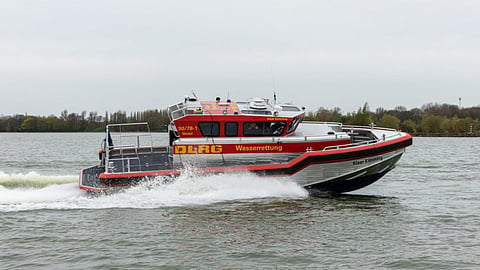
VESSEL REVIEW | Klaar Kimming – German all-weather rescue boat with remote navigation capability
Volunteer marine rescue organisation German Life Saving Society (Deutsche Lebens-Rettungs-Gesellschaft; DLRG) has taken delivery of a new response boat designed and built by Netherlands-based Habbeke Shipyard.
Klaar Kimming ("Clear horizon") has since replaced a similarly named boat that has been in service with the DLRG’s Wedel station since 1999. The organisation said that, in addition to its age, the earlier boat’s capability had offered only limited effectiveness during nighttime and winter operations.
The new boat was developed to address the earlier DLRG vessel’s shortcomings, thus making it a capable platform for operations on the Lower Elbe River.
Proven offshore vessel design adapted for emergency response

“The new boat is based on our existing daughtercraft concept, [examples of] which [are supporting] the oil and gas industry in the North Sea,” Arnoud Straakenbroek, Habbeke Shipyard’s Global Sales Director, told Baird Maritime. “Habbeke Shipyard is well known in building dedicated custom search and rescue boats for [Dutch rescue organisation] KNRM, and we had the privilege of building another boat with twin outboard engines for the DLRG station at Drochtersen.”
Straakenbroek explained that whereas the original daughtercraft design was a davit-launched boat, the boat for the DLRG’s Wedel station is a dedicated, standalone fast rescue vessel certified under ISO CE CAT B.
The DLRG Wedel station’s area of operations is the Elbe River, which serves as a recreational area as well as a waterway for large commercial vessels.
Straakenbroek said that the DLRG wanted to improve its capabilities through the acquisition of a larger boat with a cabin and waterjet propulsion to fulfil their operational requirements. The boat itself needed to have self-righting ability while the cabin had to be large enough to accommodate a stretcher-bound patient as well as first aid equipment.
Laid out for improved safety under demanding conditions
The replacement Klaar Kimming has all-aluminium construction, a length of 10.5 metres (34.4 feet), a beam of 3.42 metres (11.2 feet), a draught of only 60 cm (two feet), and space for three crewmembers and up to 12 other personnel in a heated wheelhouse.
Two Steyr SE306J38 292hp (218kW), six-cylinder diesel inboard engines drive Hamilton HJ241 waterjets via ZF 68 gearboxes to deliver a top speed of 35 knots. The DLRG said waterjet propulsion was deliberately chosen for improved manoeuvrability in shallow areas as well as reduced risks of grounding and damage from flotsam and debris.
The safety equipment includes towing and recovery gear, a remote portable salvage pump on the port side aft deck, basket stretchers, and a spineboard. Most of the equipment is mounted and stored in the wheelhouse cabin or cuddy to keep the working deck as clean as possible for safe movement around the wheelhouse and on the fore and aft decks.
The electronics suite meanwhile features a Raymarine package that includes a radar, chartplotters, a sidescan sonar, AIS, GPS, VHF radios, and CCTV cameras. A thermal imaging camera can be fitted in the future to enhance the boat’s ability to operate safely under low-light conditions.
“The other communications equipment was owner-supplied, and these include certain Tetra radios and handheld devices specially developed for the DLRG.”, said Straakenbroek.
The new DLRG boat can also be operated remotely with the aid of a Hamilton AVX portable control interface connected via nine-metre (30-foot) cable, allowing the vessel to be manoeuvred from a position other than the main helm station if needed. This will also enable the boat to be positioned accordingly to support operations under harsh conditions.
“We made an additional stand for the remote control unit on the wheelhouse roof so that it can serve as a secondary steering position,” Straakenbroek told Baird Maritime. “The Hamilton unit automatically keeps the boat in position. In this way the crew can focus on rescue activities instead of operating the boat.”
Straakenbroek said that as with other vessel newbuilding projects, the owner regularly issued new requirements, which then required the yard to be more flexible.
Also, due to the amount of communications equipment on board as well as the selected electronics with additional displays, there was limited space on the boat’s dashboard panels to fit everything in for the coxswain and navigator. As Straakenbroek explained, this issue was overcome by Habbeke Shipyard’s own engineering team, which drew all onboard systems and main components in 3D. This allowed the company to more easily adapt to changing operational requirements and to fit all critical electronic equipment in a layout that would permit ease of use.
“The DLRG boat is based on an already proven daughtercraft concept,” Straakenbroek remarked. “With the DLRG Wedel rescue boat project, we now officially have a dedicated stand-alone variant [capable of independent operation as opposed to being deployed primarily aboard and from a mother ship, –ed].”
