VESSEL REVIEW | Thames Spirit – Spill response and dive support catamaran delivered to Port of London Authority
UK builder Alicat Workboats recently delivered a new catamaran vessel to the Port of London Authority (PLA).
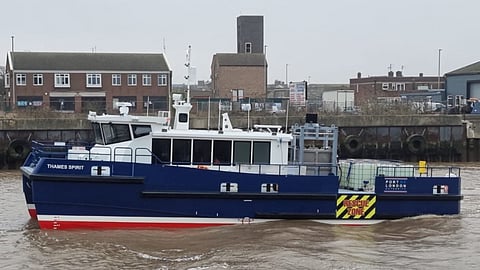
The 17- by 6.7-metre (56- by 22-foot) Thames Spirit was designed by UK naval architecture firm Chartwell Marine as a workboat capable of oil spill recovery and dive support. She will be operated by the PLA on her namesake river, particularly the stretch of the river that passes near Gravesend.
The vessel will be operated along a busy tidal river and estuarine environment covering a densely populated stretch between central urban areas and the outer estuary. In addition to performing her primary roles, she can also be employed for general environmental protection and support tasks.
Variation of an existing survey craft design

“The vessel is based on Chartwell Marine’s proven survey vessel design, developed to support shallow-water, multi-role operations including fast response, environmental support and specialist workboat duties,” Andy Page, Managing Director at Chartwell Marine, told Baird Maritime. “The platform features a highly effective, low-resistance catamaran hull form, providing strong stability and sufficient buoyancy for significant payloads within a compact footprint.”
The design is capable of operating in waters as shallow as one metre – a feature only a few vessels available in this size have – making her well-suited for constrained river and nearshore environments.
“In this specific case, the vessel has been designed to meet the end user’s requirements for oil spill response and dive support operations, incorporating a moonpool-based recovery system, waterjet propulsion, and IMO Tier III machinery within the established hull architecture,” said Page.
“The brief called for a fast-response vessel capable of operating safely in shallow, fast-moving waters while supporting oil spill recovery and dive operations,” added Simon Coote, Director at Alicat Workboats.
“Specifically, she was designed to be able to: achieve up to 20 knots for rapid response to oil spills; operate efficiently at low speeds during spill recovery; integrate a moonpool and a pump recovery system; utilise waterjet propulsion for shallow-water manoeuvrability; meet IMO Tier III emissions requirements; and be compatible with hydrotreated vegetable oil (HVO) fuel.”
Coote said the objective was to provide the PLA with a vessel designed to meet the specific demands of oil spill recovery and dive support in tidal environments, reducing reliance on multiple vessels for different tasks.
Waterjet arrangement ensuring manoeuvrability and fast transits even in shallow areas
The propulsion arrangement consists of two Scania DI13 engines driving Kongsberg S36 waterjets as well as a Northern Lights generator for supplying power for the various onboard systems, which include a Furuno radar.
“Waterjets were chosen for their manoeuvrability and suitability for shallow, debris-filled waters, while allowing the vessel to reach speeds of up to 20 knots,” said Coote. “The vessel’s machinery will also run on HVO, further reducing its overall environmental impact by up to 90 per cent, thus going above and beyond the latest international maritime regulations.”
Integrating multiple functions and systems in a compact hull
Coote remarked that, as is the case with many multifunctional vessels, the main challenge during Thames Spirit’s construction was the level of systems integration required within a compact platform.
“Particular attention was given to aligning the moonpool structure and pumping arrangements within the catamaran hull, alongside the propulsion installation and exhaust treatment systems,” Coote told Baird Maritime.
“Ensuring that all systems were seamlessly integrated into the design required continuous coordination and collaboration between the design team and builder throughout the construction process, with specific attention paid to accessibility for service and through-life care of the vessel.”
Meanwhile, in Page’s view, integrating multiple operational functions into a relatively compact platform without sacrificing performance or stability also proved challenging.
“The hull form needed to balance speed, shallow-water capability, low wash characteristics, and high stability, while accommodating specialist recovery equipment and supporting dive operations. Ensuring the vessel could achieve both high-speed transit and controlled low-speed recovery required careful attention to hull form and propulsion selection.”
For both Page and Coote, the project reinforced the versatility of the survey vessel platform for multi-role functions, particularly where specialist systems must be integrated within a shallow-water design.
“This experience will guide future projects requiring similar levels of customisation and system integration within compact workboat platforms,” said Page.
