
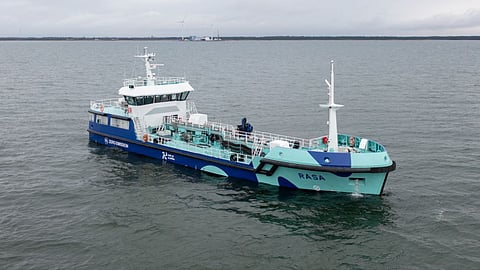
VESSEL REVIEW | Rasa – Hydrogen-electric tanker takes on waste collection at Lithuania's Klaipeda Port
A new waste collection vessel recently entered service at the Port of Klaipeda in Lithuania.
Rasa (“Morning Dew”) was built by Lithuania's Western Baltic Shipyard while Estonian shipbuilder Baltic Workboats was responsible for the vessel design, final outfitting, and systems integration.
The vessel, developed in fulfilment of a €12 million (US$14 million) investment, will be operated by the Klaipeda State Seaport Authority (KSSA), which is tasked with collecting the generated waste that ships visiting the Port of Klaipeda need to hand over in compliance with regulations.
Capable of handling a different types of liquid waste

Rasa has a length of 42 metres (140 feet), a beam of 10 metres (30 feet), and a total capacity of 400 cubic metres (90,000 gallons) of liquid waste and sludge. A hydrogen-electric propulsion system and a bilge water treatment system are also fitted.
The tanker’s main function is to collect storm water, sewage, sludge and rubbish, as well as to ensure efficient waste management. The ship is therefore equipped with dedicated storage tanks and a modern rainwater treatment plant that will allow treated water to be transferred to the sewage treatment plants in the city of Klaipeda.
Hybrid propulsion guaranteeing minimal environmental impact
The vessel is fitted with an EST-Floattech 2MWh energy storage system, two Danfoss Editron electric motors, and two 40kW hydrogen fuel cells and hydrogen storage tanks (plus accompanying software) supplied by Genevos.
The tanker was built to be capable of 24-hour operation, thus ensuring more waste will be collected from visiting ships and then processed. KSSA said that, depending on the intensity of the work, the tanker will be able to operate in the port for up to 36 hours without additional power charging.
The vessel can sail at eight knots in electric mode for over eight hours continuously, resulting in low-noise and low-emission navigation even near residential areas and in environmentally sensitive waters.
Automation allowing for a smaller crew complement
The vessel also boasts automated devices and technologies to support efficient operation by only three crewmembers while ensuring power consumption and operational profile optimisation.
The deck equipment meanwhile includes a knuckle boom crane provided by HS.Marine.
Although Rasa was built as a hydrogen-powered vessel, her hydrogen propulsion arrangement has not yet been certified, thus limiting her to operation on electric mode only. Hydrogen has nonetheless already been loaded into her fuel tanks.
