VESSEL REVIEW | ICGS Samudra Pratap – Locally designed and built pollution control ship for Indian Coast Guard
The Indian Coast Guard recently commissioned a new pollution control vessel (PCV) into service.
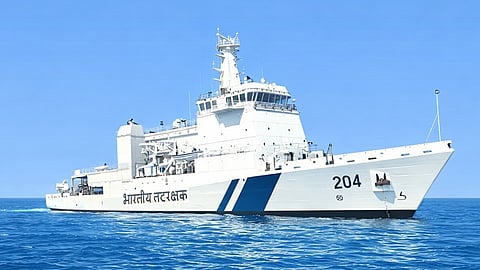
ICGS Samudra Pratap (समुद्र प्रताप) is the first in a planned class of two PCVs built by Goa Shipyard (GSL) for the Indian Coast Guard. The vessels are classed by the Indian Register of Shipping and are known as the GSL-class in Indian service.
The vessel was built with more than 72 per cent indigenous content – including her propulsion machinery – in line with the Indian Government's "make in India" initiative (whereas the coast guard’s earlier Samudra-class PCVs were all designed overseas).
Construction of the PCV was undertaken in fulfilment of a contract awarded by the Indian Ministry of Defence in 2021.
First in a new class of pollution control vessels
Samudra Pratap and her GSL-class sister ICGS Samudra Prachet – which is still under construction – were acquired to expand the Indian Coast Guard’s ability to respond to pollution incidents in India’s eastern waters, particularly the region surrounding the Andaman and Nicobar Islands.
Samudra Pratap is the first PCV to be designed and built entirely in India as well as the largest vessel in the Indian Coast Guard with a length of 114.5 metres (375.7 feet), a beam of 16.4 metres (53.8 feet), and accommodation for 129 officers and enlisted sailors.
Two 7,500kW (10,000hp) diesel engines drive controllable-pitch propellers to deliver a maximum speed of 22 knots and a range of 6,000 nautical miles. Safe navigation is possible even under rough sea conditions.
Full array of response equipment and associated electronics

The vessel's pollution response equipment includes an oil recovery system, two tenders, a radar that can detect oil slicks, dedicated booms for offshore and nearshore waters, skimmers, collecting arms that can be used while underway, tanks for storing recovered oil, and a dispersant spray system.
The pollution response suite is capable of recovering oil of various viscosities at a rate of 300 tons per hour.
The PCV will rely on a dynamic positioning system for accurate manoeuvring and positioning in areas where pollution is present, while an integrated bridge system and an automated power management system will help enhance operating efficiency.
Capable of patrol and emergency response functions
Besides the oil slick detection radar are two main radars to be used in navigation.
The PCV is armed with a CRN-91 30mm naval gun and two 12.7mm machine guns fitted on remotely controlled stabilised mounts, enabling her to conduct patrols and surveillance missions as part of her secondary functions. All of her weapons are linked to a fire control system.
The vessel also boasts salvage, search and rescue, and Fifi1 external firefighting equipment, thus giving her enhanced emergency response capability.
