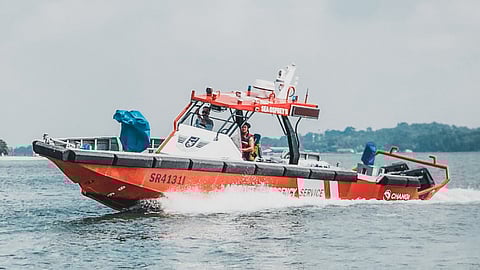


These two high-speed firefighting and rescue boats were built locally by Dundee Marine and Industrial Services for operation around Singapore’s Changi Airport by its Airport Emergency Service (AES) division.
Their rapid response capability and advanced technology were not found on the AES’s previous fleet, with each able to achieve a top speed of 40 knots while retaining excellent beaching capability.
They are equipped with powerful firefighting monitors capable of an 80-metre throw and a discharge rate of 300 cubic metres per hour. These compact, highly capable vessels significantly enhance Changi Airport’s emergency response in coastal waters.

"They were conceived from the outset as true first-response firefighting vessels," Spenser Tan, General Manager at Dundee Marine, told Baird Maritime. "The objective was never simply to build a fast boat or a FiFi boat, but to deliver a platform that performs reliably when crews are under pressure and when time genuinely matters."
Tan remarked that what really stands out about the vessels is how each one of them works as a complete system. Speed, manoeuvrability, firefighting capability, and rescue capability were all developed together rather than as separate elements, thus allowing the crew to arrive quickly, maintain control with confidence, and commence operations immediately, instead of spending valuable time managing the vessel itself.
"Like most specialised emergency vessels, Sea Osprey I and Sea Osprey II presented challenges, particularly around system integration within tight space and weight constraints," Tan explained. "High-speed craft allow very little margin, yet emergency response vessels demand a high concentration of equipment, redundancy, and accessibility.
"Another important challenge was ensuring the vessels could be handed over with complete operational capabilities, rather than simply finished builds. Advanced firefighting systems, high-speed handling characteristics, and integrated controls require not only sound design, but proper familiarisation and training. Coordinating this alongside commissioning, trials, and final delivery added complexity, but it was essential in achieving the vessels’ intended performance in service."
Tan said one key lesson highlighted during this project was the importance of early and close collaboration between the owner, designers, class, and Dundee Marine's own production team, with the operating crew involved as early as practicable. In his view, allowing sufficient time for hands-on training and realistic trials ensured that the vessels’ capabilities can be fully and safely utilised from the time they enter service.
"In our experience, a well-trained crew is just as critical as a well-built vessel - particularly in emergency response operations where confidence, clarity, and speed of action are vital."
As work on the new Changi Airport firefighting boats progressed, Tan and the rest of Dundee Marine were aware that emergency response vessel construction is being impacted by the growing emphasis on environmental responsibility and long-term compliance.
"At the same time, safety and environmental regulations are becoming more detailed, particularly around firefighting systems and onboard materials. This is driving more thoughtful, forward-looking design rather than short-term solutions. We also see increased focus on system integration, documentation, and lifecycle thinking, especially for government and mission-critical vessels."
2025 was a "strong and rewarding year" for Dundee Marine, according to Tan.
"The market remains active, but clients are more informed and more demanding," he told Baird Maritime. "Specifications are tighter, expectations are higher, and there is greater emphasis on vessels that deliver real operational value.
"Compared with previous years, there is a clear shift towards purpose-built, high-quality platforms, which aligns well with our approach. Overall, we remain optimistic about the future and the opportunities ahead."
Concurrent with what Tan said is growing client demand for specialised platforms is the evolution of the marine emergency services sector, particularly the proliferation of multi-role vessels that allow smaller crew complements to operate safely and effectively under pressure.
"Improved handling, better situational awareness, and enhanced ergonomics are becoming standard expectations. There is also growing attention on crew safety and workload management, ensuring vessels support crews instead of adding complexity during critical operations. Environmental considerations and safer firefighting solutions will also continue to shape future designs."
Meanwhile, for the broader workboat industries in Singapore and even Southeast Asia, Tan believes there is a growing preference among owners for environment-friendly, more efficient, and more specialised workboats.
"Electrification and hybrid solutions will expand in harbour operations, while conventional vessels will increasingly need to demonstrate efficiency and future readiness. At the same time, there remains strong demand for robust, mission-specific vessels designed for local operating conditions. Reliability, practicality, and proven performance remain key priorities, and we see significant opportunity in this space moving forward."
For a list of the 2025 "Best Of" award winners, please click here.

