
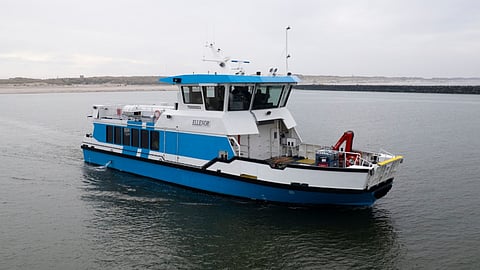
VESSEL REVIEW | Ellenor – Electric ferry for daily commuter use in Sweden's Tjorn Municipality
Tjörns Hamnar, which manages the Port of Tjörn in western Sweden’s Tjörn Municipality, has taken delivery of a new electric ferry from Hvide Sande Shipyard (HSS) of Denmark.
Ellenor was designed by Swedish naval architecture firm FKAB. Her hull was built in Poland while HSS was responsible for final outfitting.
The newbuild has since replaced Tjörns Hamnar’s existing ferry Hakefjord, which was originally delivered by HSS in 1998. The company said that, compared to her predecessor, the new vessel delivers significant upgrades in both capacity and operational functionality.
“What makes the project stand out is the combination of quiet electric operation, frequent-route passenger service and a practical foredeck arrangement that can also accept an ambulance or similar vehicle when required,” HSS told Baird Maritime. “The vessel is designed for simple daily operation, good course stability, and reliable service in both summer and winter conditions.”
The owner’s brief was for a robust and efficient passenger vessel for regular service from Rönnäng and that was approved for 180 passengers under Swedish Transport Agency requirements. Other important requirements included a service speed of around nine knots, indoor seating for at least 75 passengers, two wheelchair spaces, and improved accessibility where applicable.
Built for ease of operation

“From a builder’s perspective, the vessel also had to be practical to maintain, energy-efficient, and suitable for the owner’s route and operating pattern. For the owner, the vessel fills the need for a modern, low-emission ferry that can carry out regular public transport duties without relying on conventional diesel propulsion. It combines passenger capacity, accessibility, winter-capable operation and operational flexibility in one vessel, while reducing local emissions and supporting the owner’s route requirements.”
The Bureau Veritas-classed Ellenor has an aluminium hull, an LOA of 27 metres (89 feet), a beam of 7.2 metres (24 feet), a depth of 1.85 metres (6.07 feet), a gross tonnage of 150, and space for 180 passengers. The wheelhouse is placed on the upper deck to provide the bridge crew with unobstructed all-round visibility.
The ferry is powered by a 1,027kWh lithium iron phosphate battery pack that drives two Danfoss Em-PMI540-T1500 250kW motors connected to Korsør fixed-pitch propellers via shaftlines. This configuration delivers a maximum speed of 11 knots.
“The setup is dimensioned for the vessel’s normal service speed of around nine knots,” said HSS. “A 75kW bow thruster is also included to support manoeuvring, docking and frequent harbour operations.”
The propulsion arrangement also includes two John Deere 6068AFM85 auxiliary engines each rated 129 kW at 1,500 rpm. A DC-based power distribution system with inverters and transformers manages both the propulsion and the onboard systems.
The ferry also boasts shore charging capability as well as an energy management system and comprehensive alarm monitoring. FKAB said battery charging will be handled both via onboard converters and directly from shore using rapid DC charging, depending on port infrastructure.
“The interesting part is that the propulsion plant is part of a complete electric operating concept, not just a replacement of diesel engines with electric motors,” HSS told Baird Maritime. “The propulsion, battery system, converters, shore charging and automation all have to work as one integrated system, matched to the vessel’s route and timetable.”
The electronics setup is based on a Furuno navigation and communication package supplied and installed by Vest-El. The bridge equipment includes a FAR2218BB-NXT radar with XN-20-CF antenna and 24-inch Hatteland monitor, a MaxSea TZ Professional chartplotter system with dedicated computer, a C-Map chart and UPS, an SC-70 satellite compass with RD-20 repeater, an FA-170 AIS with pilot plug, a GP-170 GPS, an FE-800 echosounder, and a DS-85 speed log.
Fitted with comprehensive monitoring and automation systems
The communication and safety package includes Zenitel PA, talkback and batteryless telephone systems, two Furuno FM-8900S VHF radios, Entel handheld VHF/GMDSS units, Jotron Tron 60AIS EPIRBs, and a Jotron Tron SART-20.
The vessel is also fitted with a HIKvision CCTV system with NVR and six fixed cameras, displayed on a Hatteland monitor, together with a Simrad AP70 MkII autopilot system including an AC80S pilot computer, RF45X rudder feedback and FU-80 remote control. NorSap seats are available for the crew in the wheelhouse.
“The vessel is equipped with a METS integrated automation system, which is used for control, monitoring and alarm handling of the main vessel systems,” said HSS. “This includes supervision and control interfaces for the electric propulsion plant, batteries, converters, shore charging, switchboards and relevant auxiliary systems, giving the operator a clear overview of vessel status from the wheelhouse and supporting safe, efficient one-man operation.”
HSS believes the most important feature electronics-wise is the integration of navigation, communication, CCTV, autopilot and automation into a clear wheelhouse setup. This gives the operator a good overview of route navigation, vessel status, alarms, propulsion availability and charging readiness, which is especially important for frequent departures and one-man operation.
Commuter platform with secondary vehicle transport function
The vessel has a bow ramp and a hydraulic ramp system for loading, with a foredeck designed for a minimum deck load of five tons.
She is also fitted with a TMP Hydraulik 900K marine crane on the foredeck. The crane has a 3,000kg maximum load, a 9.1-metre (30-foot) maximum reach, 365-degree rotation, Scanreco remote control, PVG valve arrangement and stainless-steel fittings. HSS said these attributes provide the vessel the additional flexibility needed for lifting and handling tasks.
“The combination of a vehicle-capable foredeck, bow ramp and foredeck crane makes the deck arrangement more versatile than a conventional passenger-only ferry. It gives the owner practical flexibility for loading, service work and special transport tasks without compromising the vessel’s normal passenger function.”
From HSS’ perspective, the main design challenge was in combining the owner’s operational requirements within a compact 27-metre platform.
“The design had to balance passenger flow, crew access, wheelchair spaces, maintenance access and the structural requirements for the foredeck vehicle arrangement,” HSS told Baird Maritime. “At the same time, the energy concept had to match the route profile, with battery capacity, charging time, installed power and vessel weight all considered together from the earliest design stage.”
HSS said the main challenge in building the vessel was in integrating the electric propulsion, battery, charging and automation systems into a platform that had to be simple, robust and reliable for daily public transport service. This required close coordination between the yard, designer and suppliers, particularly around system interfaces, access for maintenance, monitoring and alarm handling.
Weight distribution and trim also required careful attention, as the vessel needed to be able to perform consistently under different passenger, consumable and deck-load conditions.
“This project confirmed the value of early coordination between the owner, designer, equipment suppliers and yard on electric vessel projects,” HSS remarked. “For future builds, we can apply the experience gained in matching battery capacity, charging infrastructure and route profile before the main technical choices are locked.”
The company said it also gained useful experience in arranging electric propulsion and automation systems so they remain straightforward for the crew to operate and maintain.
