
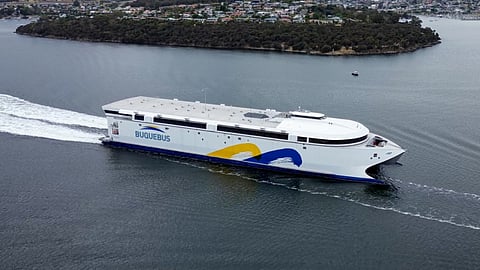
VESSEL REVIEW | China Zorrilla – Uruguay's Buquebus to operate world's largest fully electric ferry
With the completion of the Ro-Pax ferry China Zorrilla for long-standing, and equally brave, Uruguayan customer Buquebus, Incat has, as it claims, “set a global benchmark for sustainable maritime transport and proves that large scale zero-emission solutions are ready now”.
That is a big claim and she is indeed a big ship, a 130-metre (430-foot) aluminium catamaran that will soon be carrying 2,100 passengers and 225 cars at 25 knots across the Rio de la Plata from Buenos Aires to Colonia six times a day, all on electric power. She is, by far, the world’s largest battery electric ferry and is four times larger than the next biggest.
Expanded capacities for point-to-point sailings

While the Buquebus vessel named after a famed Uruguayan actress and producer is an exciting and impressive development, she is only practical in places where plentiful renewable or nuclear electricity is available.
While Argentina, Scandinavia, Canada and New Zealand have attractive possibilities, Australia and South-East Asia remain unlikely. However, in the right places, the move to electrically powered vessels is very definitely on ( Incat has already commenced construction of two 129-metre (420-foot) battery electric aluminium catamaran ferries for another repeat customer, and construction is well underway on a pair of 78-metre (260-foot) hybrid electric ferries for another export customer).
Alongside and, especially aboard, the new ship seems huge. With three wide-open decks covering most of her 130-metre overall length and 31.5-metre (103-foot) Panamax beam, her capacity, particularly on its car and duty-free shop decks, is enormous. The duty-free shopping area covers around 2,300 square metres (25,000 square feet) and is reminiscent of a major international airport.
There is a vast atrium in the ship’s centre linking the shopping and very comfortable, triple class passenger seating areas. Overall, the furnishings, fittings, toilets and the interior are top class.
Waterjet propulsion optimised for shallow inland waters
Even in the hulls, where the battery rooms and power plants are stored, the ship seems cathedral-like. There is plenty of space and plenty of air. She needs both, of course, with four 2,400kW (3,200hp) electric motors and four very large waterjets (two steerable and two boost) in each hull.
The wiring involved is impressive and the Corvus Dolphin lithium-ion energy storage system produces 41.2 MWh, enough to power a small town. That is equivalent to the battery capacity of more than 850 electric cars.
The battery modules are also notable for having individual cooling and monitoring systems. The modules are fixed without requiring conventional racks, thus enhancing airflow to aid in cooling.
The batteries are charged using dedicated infrastructure at both stops of the ferry’s route. A charging time of 40 minutes will enable the vessel to sail one-way along the 55-kilometre (34-mile) stretch of the Rio de la Plata between the Argentine capital of Buenos Aires and the city of Colonia del Sacramento in Uruguay.
Enhanced safety features
The original design brief had called for the installation of engines that operate on diesel and LNG. As construction progressed, however, both Buquebus and Incat agreed to make the ferry a fully electric vessel instead.
According to Incat, the switch to electric propulsion reduced the vessel’s overall weight. This then made it possible for smaller waterjets to be fitted. The resulting reduced weight and smaller footprint also make it easier for the vessel to navigate along her intended route, which includes portions that are only around 2.5 metres (8.2 feet) deep.
As with all modern catamaran ferries, safety is ensured with multi-compartmented hulls and two separate engines, fuel and propulsion systems. She is as close to unsinkable as it is possible to be. The very lightweight aluminium construction and excellent fire suppression and insulation systems reinforce that fact, as do all the ship’s fireproof flooring, seating and furnishing materials.
In the unlikely event of an accident, the ship is equipped with six marine evacuation systems and 13 linked liferafts that can hold more than 2,400 passengers.
The ferry recently completed undergoing harbour trials, during which she executed a carefully managed series of movements on the Derwent River in Tasmania, allowing crews to test propulsion, manoeuvrability, control systems, and onboard operational performance in real-world conditions.
The harbour trials formed part of an extensive testing and commissioning program that continued in the lead-up to the vessel's delivery. Before that, during early trials, she even achieved 29 knots while carrying 600 tonnes of cargo.
Incat Chairman and catamaran ferry pioneer Robert Clifford said that moving the ferry under her own battery-electric power confirms that electric propulsion is viable for large commercial vessels.
Clifford is obviously, and very deservedly, proud of his company’s creation. As he showed us around his magnificent ship, it was easy to see that, even at 83 years old, he knows every detail of all his vessels.
Indeed, after 100 completed ships and with five more big ones under construction, he has big plans for the future. While commencing construction of a new 300-metre (1,000-foot) building hall at the company’s existing Hobart shipyard, he has purchased a riverside cherry orchard some miles up the Derwent River where the company will construct an additional three building halls.
Clifford is even thinking of another attempt at establishing a Bass Strait Ro-Pax ferry service using a very large electric ferry.
While a truly “breakthrough” ship, China Zorrilla remains a link in a considered and logical design and construction evolution. In its near fifty-year history, Incat and Robert Clifford have experienced almost every imaginable “up and down” of shipbuilding and business generally. However, unlike most of their competitors globally, they have survived and thrived. Indeed, the company’s productivity and profitability are at peaks and its possibilities appear limitless.
Review written by Baird Maritime Co-Founder and former Editor-in-Chief Dr Neil Baird
