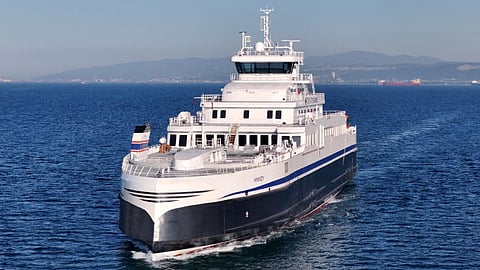

This large, modern battery-electric double-ended Ro-Pax ferry was designed by the Norwegian Ship Design Company (NSD) for Torghatten Nord to operate on the busy Bognes–Lødingen crossing in northern Norway.
For the advanced battery-electric propulsion system, a substantial 4.75MWh battery pack powers two 1.8MW electric motors connected to azimuthing controllable-pitch propellers, delivering a service speed of 14 knots and enabling efficient one-hour crossings.
Hinnøy represents a significant step forward in sustainable, high-capacity ferry operations along Norway’s coastal routes.

"As it would serve the longest fully-electric ferry crossing in Norway, a one-hour crossing powered entirely by electricity, in partially exposed and challenging waters with a closed vessel design, is truly pushing the boundaries," Gaute Larsen, Head of Technical at Torghatten, told Baird Maritime. "High-voltage power lines have also been installed on shore to handle the required power demand."
Larsen remarked that it was challenging to handle charging at the power levels the company is working with without affecting grid capacity and stability on shore. Because only 15 minutes of charging time are available prior to a one-hour crossing, it required a high degree of automation and strict operational discipline.
For NSD, the new ferry is a cutting-edge, environmentally friendly vessel purpose-built for demanding open-water conditions. The high-capacity battery system permits one-hour crossings on electricity alone. As a backup system, four variable-speed biodiesel generators are installed – two fore and two aft.
The vessel's low-resistance hull form is optimized for reduced power consumption and superior seakeeping, which the designer said is crucial for crossing open fjord waters. The ferry charges its two water-cooled battery packs after each trip, but the capacity has been oversized to extend battery life and reduce charging time.
Upon seeing the ferry in operation for the first time in January of this year, NSD expressed satisfaction that the ferry performed well and that it generated positive feedback among both crew and passengers, who described riding on the vessel as comfortable, pleasant and safe.

Although the ferry's battery system has already proven its ability on operations, Larsen has reiterated the importance of being mindful of the regulatory environment, as it also has an impact on vessel operations.
"We must continuously monitor regulatory changes, including those related to onboard battery systems, and ensure that we remain compliant. We maintain a strong dialogue with the national maritime authorities, who are also committed to ensuring that regulations keep pace with developments in zero-emission vessels."
Larsen added that Norway is at the forefront, particularly in electrification, and that the country's authorities need to be duly credited for creating a framework that enables progress.
Torghatten is set to welcome new vessels into service this year, a slight improvement over 2025, which Larsen said was marked by relatively few newbuild deliveries, though the past year had provided the company with opportunities to focus on fine-tuning its operations.
"In the coming year, a number of new ferries - both electric and hydrogen-powered - will be delivered, with service start-ups across many routes," he told Baird Maritime. "This will be both exciting and demanding, and not least rewarding as we see these projects realised and brought into operation."
Larsen believes that the electrification of ferry transport, particularly in Norway, will continue, and that Torghatten remains optimistic - particularly given the experience and expertise that the company has built up in both contracting and operating zero-emission vessels.
"We assume that the EU and IMO will keep working relentlessly towards the goals they have set [in terms of electrification], which will impact the industry overall as the bar is raised," Larsen remarked. "Especially within shortsea shipping, electrification will pick up momentum in tandem with the development of batteries and charging technology. Other energy carriers will be relevant for longer distances, and we think there is a relevant place for most of the contending fuel types."
Larsen added that stricter requirements and regulations will also increase the focus on the need to achieve fuel efficiency, which is an overall positive development regardless of the energy carrier or the propulsion system.
As for the Scandinavian maritime industry, Larsen observed that the countries in the region are focused on achieving their respective emission reduction targets.
"There is naturally a fair amount of discussion around geopolitical events and tensions, but emissions reductions are continuing steadily," he told Baird Maritime. "Although we can’t assertively speak for the whole region, Norway's own maritime cluster seems well-poised to play an important role in the maritime green transition.
"As the pioneering phase of electric propulsion is coming to a close, we assume there will be a focus on industrial standardisation moving forward, as well as less tailoring, especially when it comes to charging infrastructure and interfaces, grid interaction, peak shaving and load management."
For a list of the 2025 "Best Of" award winners, please click here.

