
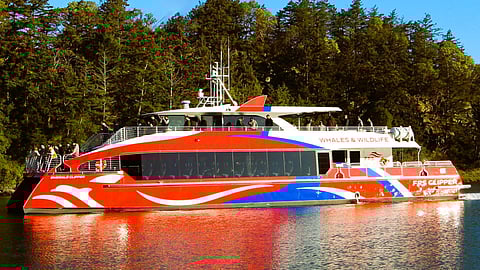
VESSEL REVIEW | Emerald Clipper – Catamaran providing enhanced passenger views for whale-watching in Washington's Puget Sound
Seattle-based tour operator FRS Clipper has taken delivery of a new catamaran vessel built by Mavrik Marine of La Conner, Washington.
The 103-foot (31.4-metre), all-aluminium Emerald Clipper was designed by One2Three Naval Architects of Australia in compliance with US Coast Guard Subchapter T requirements. She will be operated out of Seattle on whale-watching excursions in Puget Sound and the Juan de Fuca Strait, though the owner will also take the vessel to its base in Victoria, British Columbia.
“The vessel was designed to provide a maximum, unimpeded, outside viewing opportunity,” Bailey Shewchuk, President of Mavrik Marine, told Baird Maritime. “An elevated centre seating platform provides enhanced viewing for centre-seated passengers while all passengers can take advantage of the vast outside viewing capability provided by floor-to-ceiling, full cabin, windows.
“Forward looking, all passengers can also experience the captain’s view with windows between the passenger cabin and the pilothouse, and out to the bow deck. The full, three-sided glass cabin brings the outdoors inside, providing a comfortable, airy, passenger experience.”
Laid out to ensure an enhanced viewing experience whether inside or outside the main cabin

Shewchuk added that the vessel, approved for 150 passengers, has 186 seats, allowing passengers to have ample room to both spread out and to enjoy either indoor or outdoor seating arrangements. Thus, no matter the passenger’s preference, whether indoor-heated and air-conditioned comfort or outdoors, space on the vessel is available for them.
“Passenger comfort and viewing experience were paramount in the client’s requirements,” said Shewchuk. “Starting from the upper level of the vessel, the client wanted all deck space accessible to passengers, allowing unimpeded access and flow for passengers to experience the outdoor environment or the comfortable indoor amenities.
“The pilot house location and visibility were important with respect to the vessel operation, but the client also wanted passengers to have access to the areas surrounding the pilothouse, to be able to observe the vessel operations. Comfort was also of the utmost importance, to ensure the vessel provided accessible services and conveniences for all passengers.”
To that end, the main deck galley, which provides hot and cold food and beverages, has been made accessible to all passengers. Special accommodation was also made to accommodate wheelchairs and passengers requiring easy access.
Toilets are located on the main deck, and these include an ADA-compliant restroom with easy door access and ample room. The vessel also needed to provide facilities for education with a main deck naturalist station, a public address system, and video monitors positioned on both decks allowing for audio and video informational and educational content to be provided to and enjoyed by all passengers.
The vessel is crewed by four to eight personnel. Four Scania DI16-082M US EPA Tier III diesel engines drive Hamilton HTX42 waterjets via ZF 665SC gearboxes. Controls for the waterjets is via a Hamilton AVX system while twin Koehler generators supply electrical power for the various onboard systems.
“Below deck, the client required a highly efficient propulsion system that would allow speedy transfer of passengers from the docks to the wildlife and whale viewing areas,” Shewchuk told Baird Maritime. “Mavrik Marine delivered a vessel capable of cruising at over 38 knots, and the client optimised its schedules to minimise fuel consumption while maximising operational efficiency, comfort, and safety.”
Full electronics suite coupled with enhanced amenities
The pilothouse is equipped with multiple multi-function displays as well as dedicated system monitoring displays and interfaces. The Furuno radars are complemented by chartplotters, depth sounders, and communication systems.
The vessel also includes a highly integrated function and performance monitoring system, as well as video display and recording system.
The other key equipment includes boarding gates, which Shewchuk said had to be designed and located accordingly in order to accommodate a variety of boarding requirements depending on current and potential docking locations.
“The owner was very particular about the vessel’s exterior appearance and design. The colours, graphics and visual appeal were highly scrutinised in the design phase. The specific look was accomplished with a whole vessel vinyl printed wrap providing the colour and graphics required.”
He added that the client was also very particular about the equipment that would provide customer food and beverage services. Integration of a commercial espresso machine and high-speed hot food ovens was therefore deemed essential.
“For the client, having a vessel available for the 2026 season was critical to operating plans. Establishing a collaborative project team between the client and the shipyard was therefore key to Mavrik Marine delivering the vessel five weeks ahead of schedule and having it ready for the 2026 season.”
Continuous fine-tuning that is also applicable to other vessel projects
Shewchuk explained that the biggest challenges in building Emerald Clipper came from the complexity introduced as a result of governmental tariffs, sanctions, priorities and positions impacting machinery procurement and prices.
"The major equipment for vessels like these comes from many places around the world," he told Baird Maritime. "The availability of imported components, as well as fluctuating prices, is a difficult process to manage, and unsettling for the client."
Nonetheless, Mavrik Marine learned that optimising production engineering processes is an ongoing effort. As Shewchuk himself said, the company regularly evaluates its performance to determine areas of further improvement.
“We ask ourselves, ‘How are we better today than yesterday?’ For instance, the X-bow design requested by the client required specific design considerations to provide the visual design the client wanted above the waterline while optimising the vessel hull performance below the waterline. The expansive windows on the main deck provide a unique passenger viewing environment that we would recommend on future sightseeing vessels but we also introduced some unique installation and glazing techniques that can be utilised in the future.
“Maximising vessels’ performance and efficiency are always analysed and small ‘tweaks’ of design, integration, and operation are always fine-tuned for use in future production.”
Emerald Clipper has replaced the 85-foot (26-metre) San Juan Clipper, which was delivered in 1990. In addition to providing an increase in daily passenger capacity, the newer vessel also offers improved passenger comfort, increased range, and greater reliability.
