
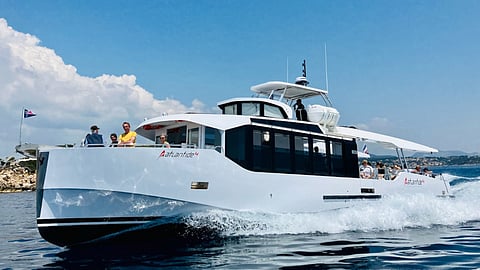
VESSEL REVIEW | Atlantide IV – Composite tour boat for operation in France's Calanques National Park
French shipbuilder Chantier Naval Gatto has completed construction of a new sightseeing vessel boasting structural elements made from reinforced composite material.
Atlantide IV was developed from the outset to incorporate composites in her construction to ensure a lower overall displacement and reduced environmental impact. Design work on the vessel was provided by French naval architect Eric Jean.
The aim of the project was to build a modern, lightweight and environmentally friendly passenger boat suitable for daily tourist navigation.
The boat also needed to be able to reach the Calanques National Park in Marseille quickly from Bandol in southeastern France some 40 kilometres (25 miles) away.
Various operating modes depending on sailing requirements

Classed by Bureau Veritas, Atlantide IV has an LOA of 18.2 metres (59.7 feet), a beam of 4.6 metres (15 feet), a gross tonnage of 41, space for 70 passengers, and a hybrid propulsion arrangement that includes a diesel engine and solar panels.
The diesel engine will enable fast transits between the two main stops while the electric operating mode will allow for quiet navigation in park waters.
The open seating configurations can accommodate sightseeing groups, while modular elements will enable setups for corporate functions or educational tours within the Calanques park. The accommodation spaces have been laid out in compliance with French maritime safety standards.
Composite material for improved durability and performance
Because of the lightweight composite construction using material from Saertex, the vessel enjoys improvements in fuel efficiency, manoeuvrability, stability, and resistance to corrosion.
She is also able to achieve higher sailing speeds, making her suitable for daily trips even in environmentally sensitive waters, while her enhanced manoeuvrability will help her easily navigate through the many inlets of the park.
The composite construction ensures that there is no water absorption into the core in case of failure of the outer skin, which can occur when navigating in rocky waters such as those in the Calanques park. This attribute is courtesy of the closed-cell core, which is ideal for placement in areas of the hull below the waterline.
Some of Saertex’s specialised fibre-reinforced materials were used for the deck, the interiors, and the hull of the boat in order to achieve an optimum balance between weight and stability.
For processing both the multi-axial fabrics and the sandwich complexes in a single step, the vacuum infusion method was used for manufacturing stable composite components. Through this manufacturing process, the materials are first placed dry in the mould and then infused with resin under pressure, resulting in an even and flawless distribution.
Saertex said that by precisely controlling the fibre orientation and resin distribution, the composites can be processed as efficiently and accurately as possible.
Atlantide IV has already commenced operations on the route between Marseille and Bandol. Even when in fully electric mode, the vessel is able to complete a one-way trip on the same route.
