VESSEL REVIEW | RK Synergy – Compact electric harbour shuttle to serve Port of Singapore
Singapore-based shipping company Hoe Ee Marine has taken delivery of a new harbour passenger vessel built by Guangdong Sinoway Composite Materials of China.
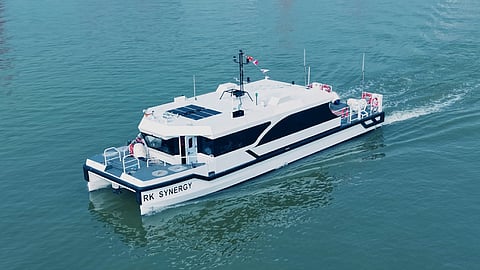
Boasting all-electric propulsion and lightweight carbon fibre construction, the 18.5-metre (60.7-foot) RK Synergy was completed as a catamaran craft capable of reaching 16 knots thanks to a total installed power of 240 kW.
Suitable for personnel transport and small-volume cargo delivery in coastal waters, she is specially developed for crew transfer and shuttle services between large vessels at busy ports and anchorages.
“The shipowner put forward clear mandatory full-dimensional customised requirements for this vessel,” SK Huang, General Manager of Sinoway, told Baird Maritime. “In terms of performance, the craft features the core advantages of zero emission, low noise and high operational efficiency, and she enables convenient full-lifecycle maintenance on the premise of comprehensive safety protection throughout all operation links.
“In terms of application scenarios, the vessel is designed for short-distance port transfer within 40 nautical miles. She can carry no less than 12 personnel per voyage and support loading and unloading of cargo up to two tons simultaneously. In terms of restrictive conditions, the overall vessel delivery cycle was strictly limited to within 10 months.”
Combining light weight, high speed and battery propulsion in a compact catamaran hull

The vessel has also obtained official approvals from the China Classification Society (CCS) to ensure compliant operation in both regions, added Huang.
“The all-electric vessel was developed in response to the Singaporean Government’s Maritime Decarbonisation Blueprint ‘Towards 2050’,” said Huang. “She fully complies with the zero-emission operation requirements for newly built working vessels within Singapore ports effective from 2030, delivering a compliant, high-efficiency green solution for short-distance crew transfer and cargo transportation to the shipowner.
“The vessel fills the market gap of zero-emission short-range passenger and cargo craft operating in Singapore’s coastal waters. She enables the shipowner to comply with upcoming environmental regulations in advance and avoid carbon-related costs and compliance risks. She will also serve as a practical and replicable demonstration model for the decarbonisation drive of Singapore’s port sector.”
The electric propulsion setup is a twin-shaft scheme consisting of dual permanent magnet synchronous motors and twin fixed-pitch propellers. The power source is an onboard 720kWh lithium iron phosphate battery pack. The system integrates a battery management system (BMS), motor controllers, and an energy management unit to precisely regulate power output and match power demand under various sailing speeds.
“The core highlight of this propulsion system lies in the deep integration of all-electric power, high-speed performance, and a lightweight hull,” Huang told Baird Maritime. “The system balances dynamic performance and energy efficiency under high-speed operating conditions. The power response logic is optimised for port operation scenarios, enabling rapid switching of speed modes. Meanwhile, the low-noise propulsion design greatly reduces operational noise.
“The zero-emission design of the entire system fully meets the compliance requirements for decarbonised operation within Singapore ports.”
The electronics suite meanwhile includes a radar, an AIS, an ECDIS, a GPS, a satcom terminal, VHF radios, a voyage data recorder, and various monitoring systems such as those for detecting combustible gas. According to Huang, the electronic setups adopts an integrated, lightweight design specially adapted for all-electric vessels.
“The navigation, propulsion and energy management systems are integrated to achieve unified monitoring of full-vessel data. The system can interact with the BMS in real time to adjust power output and optimise energy consumption.
“Lightweight electronic equipment was used to meet the weight reduction requirements of the carbon fibre hull so as to avoid additional weight that could compromise the vessel’s sailing speed and cruising range. Lastly, a shore-based remote monitoring terminal is equipped to monitor the vessel’s propulsion performance and battery status in real time, which satisfies the management requirements of high-frequency operation within ports.”
Electronics and deck equipment selected for safety and ease of use
The deck equipment includes fairleads, quick mooring bollards and manual winches, while an open space at the stern will be used as a cargo area. There are also lifebuoys, lifejackets, firefighting appliances, embarkation ladders, and safety guard rails.
“The value of the deck equipment lies in its lightweight, compact and scenario-targeted design for port operations,” said Huang. “Lightweight deck equipment was adopted to further control the overall vessel weight and achieve total weight reduction in combination with the carbon fibre hull, while the layout of equipment is optimised to ensure access passages and operating space within the limited deck area, balancing safety and practicality.
"Also, quick mooring fittings are equipped to meet the frequent berthing and unberthing demands of port operations, improving the vessel’s operational turnover efficiency."
The vessel also features what Huang described as eco-friendly and low-consumption interior materials as well as energy-saving lighting systems for cabins to reduce non-propulsion energy consumption. The optimised low-noise design of the whole vessel, combined with the quiet advantage of all-electric propulsion, greatly improves the working comfort of crew members.
“Lightweight design is the core principle behind the selection of all onboard equipment,” Huang explained. “Together with the carbon fibre hull structure, the vessel achieves maximum weight reduction so as to strike a balance between sailing speed and cruising range. In addition, all equipment complies with the environmental protection and safety standards for port operation in Singapore, providing comprehensive support for zero-emission navigation.”
Overcoming regulatory compliance and other challenges leading to insights to be applied in later builds
For Huang, construction of RK Synergy encountered challenges in the areas of regulatory approval and project scheduling.
“As a vessel adopting all-electric power, high-speed design and a carbon fibre structure, she required much longer periods for compliance verification and drawing approval by CCS compared with conventional vessels,” he told Baird Maritime.
“Consequently, the time available for equipment procurement and ship construction was greatly shortened. This placed extremely high demands on our precision in project planning, milestone management and resource allocation, and we were still required to deliver the vessel with guaranteed high quality within a shorter timeframe.”
Huang said that finding an ideal balance between low weight, electric propulsion and high-speed operation proved to be another challenge during construction, as the combination of the other two factors imposed strict requirements on full-process weight control.
“Every procedure from material selection to construction implementation needed to be precisely managed to ensure the vessel meets all performance indicators. On the other hand, restricted by the vessel’s overall dimensions and onboard space, we needed to strike an optimal balance between sailing speed and cruising range. It posed an entirely new challenge to our overall design optimisation, power system integration and construction techniques.”
Nonetheless, Huang said that work on RK Synergy established an implementable and replicable standardised experience encompassing carbon fibre fabrication technology, catamaran structure design, all-electric propulsion, interior layout, center-of-gravity control and quality inspection procedures.
“We feel that, for the subsequent construction of carbon fibre electric catamarans, sightseeing boats and official service shuttle craft of the same class, we can directly adopt proven solutions so as to cut trial-and-error costs, shorten design and construction cycles, and unify product quality and seaworthiness performance,” Huang told Baird Maritime.
