VESSEL REVIEW | Nino – Low-profile electric ferry and tourist shuttle for Russian river crossings
Russian passenger vessel operator Vodohod, though its subsidiary Vodohod Passenger Port, has introduced a new electric vessel on an urban water crossing in Nizhny Novgorod.
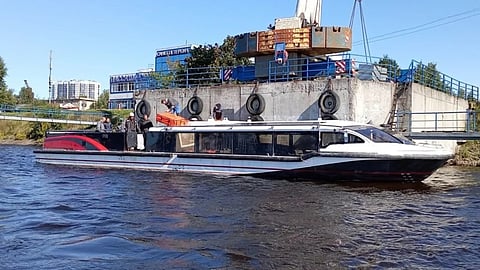
Nino (Нино), the lead vessel of Project Fontanka 2.0 (F2) series, made her first passenger trip on the Chkalov Staircase–Strelka route on September 17, 2026.
The vessel was built by Rechnaya Shipyard in Saint Petersburg to a design by AN Marine Consulting.
The operator said Nino was specially prepared for the new crossing, which serves both residents and tourists and takes approximately 20 minutes per trip.
Optimised for operation along inner city routes
The Project F2’s design was developed for inland passenger transport and sightseeing. When construction began, the Russian Maritime Register of Shipping (KM) said the vessel was "fully adapted to serve sightseeing tourist routes in Saint Petersburg. In particular, it has a restricted vertical dimension, which will ensure safe operation on the city's rivers and canals, taking account of the low bridges."
Nino has a length of 20 metres (70 feet) and a beam of 5.3 metres (17 feet), and the operator listed her capacity at 80 passengers. Her published sightseeing speed is 5.4 knots, while operator figures released at the time of her launch gave a maximum speed of 6.5 knots.
The vessel uses electric propulsion, which the operator said provides quiet running without vibration.
Alfa Balt Marine described Nino as a hybrid electric vessel and said it had installed a diesel generator inside a dedicated noise-attenuating enclosure. This area of the vessel substantially reduces noise and vibration, and most of the generator's auxiliary systems were integrated into it, reducing installation work aboard.
Swappable batteries ensuring faster turnarounds

The F2 design also uses standardised, exchangeable battery modules. Depleted modules can be removed and replaced at charging stations along the route, so the vessel does not need to stay alongside while her batteries are being charged.
Passengers have access to both enclosed and open areas with glazing extending over two-thirds of the deck.
The accommodation is served by air conditioning and split systems, and onboard amenities include a bar, toilets, a television and a music system.
Nino was built to KM class under the technical supervision of the classification society's Baltic branch. Her class notation is КM⍟ IN Р 1,2.
Construction of the vessel began at Rechnaya in October 2025, and she was launched at the shipyard's Saint Petersburg production facility on July 25, 2026.
KM issued her classification documents on September 11, and Alfa Balt Marine later confirmed that the vessel had been handed over and entered service.
A second Project F2 vessel was laid down at Rechnaya on January 23, 2026. Named Gor, she is scheduled to join Nino on the Chkalov Staircase–Strelka crossing for the 2027 navigation season.
