Fire in the 'Norman Atlantic'
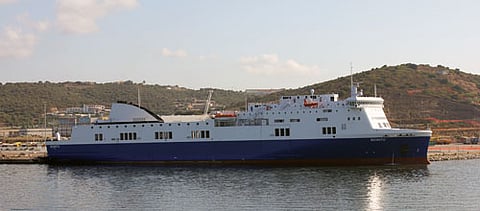
'Norman Atlantic' Photo: Eustace Bagge
The 'Norman Atlantic' fire at the end of last year once again plunged the ferry sector into the media spotlight for all the wrong reasons and indeed marked the end of a tragic year which recorded the loss of the ferry 'Sewol' in South Korea, in which 304 passengers, mainly children, died.
Over 400 passengers were rescued from the Italian-flagged 'Norman Atlantic', operated on charter by Greece's Anek Lines, which caught fire in the Adriatic in heavy weather on December 28. The vessel was sailing as a replacement for another chartered-in ferry and had been operating on the route for just 10 days when the incident occurred. The Crete-based ferry company, which operates on the route under a joint service agreement with fellow Greek operator Attica Group, said that the vessel was in possession of all required safety certificates and had undergone the necessary safety inspections.
As to the cause of the blaze, one suggestion is that the semi-open upper vehicle deck that accommodated hazardous cargoes acted to fan the flames, which might not have happened had they been starved of oxygen. This is speculation of course and in my opinion whether the fire started in a vehicle on the upper deck or on the enclosed lower (main) deck would have mattered little. A fire on a ship rarely ends well.
In November 2013, a fire broke out on the forward part of the semi-open vehicle deck of the DFDS Ro-Ro cargo ship 'Britannia Seaways' on passage from Sørreisa to Bergen, Norway. The ship was carrying military equipment and vehicle flat racks with a large number of jerrycans and tank containers with petrol and jet fuel. There were also 12 passengers, all of whom were military personnel. When that fire broke out, there was a storm and heavy seas in the area. During severe rolling a tank container became loose and caused petrol to leak. This in turn was ignited by sparks generated by a tank container that slid across the deck, steel against steel. The fire quickly flared onto the jerrycans and tank containers and became immense. In this case, the firefighting was successful in spite of adverse weather, because (according to the Danish Marine Accident Investigation Board) the ship's officers and crew expediently utilised resources available to them.
The revelation that a port state control inspection of the 'Norman Atlantic', as recently as December 19, discovered malfunctions on the fire doors brought an immediate media reaction, even though owner Visemar di Navigazione insisted that the deficiency was addressed immediately.
The ship reached the anchorage of Brindisi on January 2 under the escort of two tugs, the 'Ionian Pelagos' and 'AH Varazze', but not before two seamen lost their lives during the operation after a connecting cable parted when it became entangled in a propeller. One man died instantly, the other died while being assisted by a helicopter medical team.
Italian prosecutors have launched a criminal investigation into the accident and were taking testimony from survivors brought to Italian ports. Greece's Minister for Shipping and the Aegean, Miltiadis Varvitsiotis, vowed that there would be a full inquiry following the immediate rescue effort.
"A fire on a ship rarely ends well"
Captain Argilio Giacomazzi, the master of the ferry, was questioned for five hours by investigators in the port of Bari. His decision to be the last off the ship has been favourably contrasted with the conduct of Captain Francesco Schettino, the master of the ill-fated 'Costa Concordia', who is on trial for allegedly abandoning the cruise ship while hundreds of passengers and crew were still on board after it capsized off the island of Giglio in Jan 2012. Captain Giacomazzi insisted that, "all safety procedures were respected" – a claim which sharply diverges from the testimony of survivors, who said that passengers fought to be rescued and that the crew were nowhere to be seen as the blaze spread out of control.
In addition to the vessel's master and the head of the shipbuilder Cantiere Navale Visentini, four more people were put under investigation by the prosecutor's office in Bari, two crew members and two representatives of the Greek ferry line Anek.
The tragedy will no doubt be the focus of a major ferry safety conference to be held in the Philippines in April 2015. The location for the event is noteworthy. The collision between 'Dona Paz' and a tanker in that country in December 1987 claimed at least 4,375 lives. The Philippines also witnessed the 'Princess of the Stars' casualty in June 2008, which killed at least 800.

'Princess of the Stars'
The IMO and Interferry have been working on the question of ferry safety in Asia through a body called the Regional Forum on Domestic Ferry Safety. Key among its recommendations are calls for improved accident investigation and better information sharing.
Justin Merrigan
