
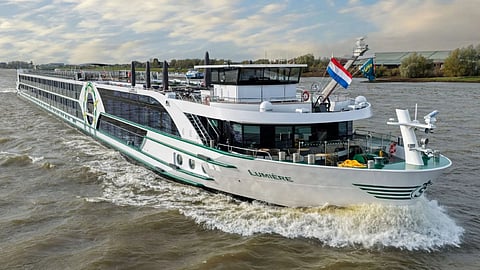
VESSEL REVIEW | Lumiere – Swiss river cruise ship operated as autonomous systems testbed
Switzerland-based transport operator Scylla recently took delivery of a new river cruise ship built by Vahali Shipyards in Serbia.
The 135-metre (443-foot) Lumière was custom-designed in collaboration with US luxury travel company Tauck to accommodate no more than 130 guests in 22 300-square-foot (28-square-metre) suites (with separate showers and walk-in closets), 34 225-square-foot (21-square-metre) cabins, and 12 180-square-foot (17-square-metre) cabins. The ship was specifically built for cruising along the Rhône River.
Two decks feature floor-to-ceiling windows and French balconies where guests can take in the surroundings from the relative safety of their cabins.
Full range of amenities coupled with hybrid propulsion

The ship also boasts one of the highest guest-to-staff ratios on Europe's rivers, with 50 crewmembers including a dedicated cruise director, local guides, and personnel providing around-the-clock onboard security.
The other guest facilities include two restaurants, a sun deck with pool and bar, a gym, a yoga studio, and a massage room. These and the other onboard spaces feature LED lighting as an energy saving measure.
As with other river ships in the Scylla fleet, Lumière’s wheelhouse was placed as far forward as possible to provide the bridge crew with improved visibility ahead. The wheelhouse was constructed by Kampers Shipyard in the Netherlands.
The hybrid propulsion arrangement includes two MAN D2682LE444 1,000hp (750kW) main diesel engines, three MAN D2676LE328 generators, three Stamford S5L1M generators, a Stamford UCM274 generator, and two 67kWh battery packs.
The engines drive two Veth Z-drives with contra-rotating propellers and a Veth 390kW manoeuvring jet.
When operating on battery power alone, the ship for approximately 45 minutes. This solution is ideal as a backup means of propulsion, such as when heading to the nearest available port following an emergency that would prohibit the use of the main engines.
Comprehensive electronics and deck equipment selection
The onboard electronics include Furuno radars, an echosounder and anemometer from Radio Holland, and a BAM Pro Marine package consisting of fire alarms, a PA system, CCTV cameras and an intercom system. The galley and restaurant equipment were supplied by Ahorn Grootkeukentechniek.
The deck equipment supplied by Dijvler Materiaal includes winches, anchors, capstans, and mooring lines. Klimaatservice Holland supplied the vessel’s HVAC and toilet systems while the box coolers are from NRF Holding.
Scheepvaartwinkel Marine supplied the ship’s fire extinguishers while a Jeanneau outboard-powered boat will be used in MOB rescues.
Secondary role as autonomous technology demonstrator
Lumière has also been used as an autonomous navigation testbed. In October last year, barely two weeks after entering service, the ship sailed between Hardinxveld-Giessendam and Gorinchem in the Netherlands purely on autonomous mode as part of a demonstration project.
The demonstration combined Retina’s manoeuvring system with the autonomous lane assist (ALA) system from Shipping Technology (ST), thus enabling the ship to undock, sail, and dock autonomously under real-world conditions.
Throughout the route, the ship's captain remained in full control and supervision, always ensuring safety. ST said that even a gale-force crosswind of Beaufort eight did not affect the ship’s course during the voyage.
During the demonstration, the Retina manoeuvring system controlled both the thrusters and the engines of the vessel, operating in conjunction with ST's ALA system.
Together, these systems guided the vessel along the optimal route from between Hardinxveld-Giessendam and Gorinchem, automatically managing rudder and pod movements with greater precision.
ST said the system continuously factors in variables such as vessel load, engine rpm, and desired turning acceleration to determine the most efficient steering response.
