
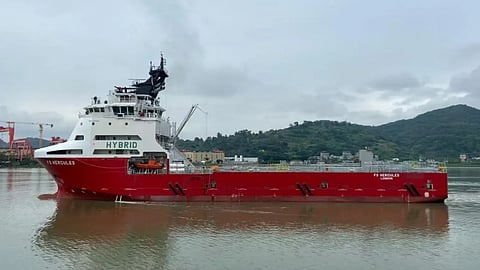
VESSEL REVIEW | FS Hercules – Hybrid supply vessel with secondary ROV support function
Norwegian operator Hercules Supply has taken delivery of a new multi-purpose supply vessel (MPSV) built by Fujian Mawei Shipbuilding in China.
The 88.8- by 20-metre (291- by 70-foot) FS Hercules was designed by Norwegian naval architecture firm Breeze Ship Design. She will be operated by UK-based vessel management specialist the Fletcher Group, which will serve as both commercial and technical manager.
Fujian Mawei is also building another two MPSVs from the same series for Hercules Supply.
“She is an MPSV developed from a proven and well-established design platform,” Breeze Ship Design told Baird Maritime.
“She is primarily intended to operate as a high-capacity supply vessel, featuring an extensive open cargo deck of approximately 1,000 square metres (11,000 square feet) and substantial cargo tank capacity below the main deck for the transport of various liquid and bulk cargoes.”
Expanded space for an integrated moonpool and additional accommodation

Breeze Ship Design said that at the same time, the design placed strong emphasis on flexibility and multi-role capability. Compared to conventional supply vessels, she offers significantly increased accommodation capacity to support industrial personnel.
The vessel is also equipped with a removable cargo rail system, enabling efficient deployment of remotely operated vehicle (ROV) operations, and is prepared for the installation of a moonpool. Accommodation is available for up to 60 personnel.
“Further capabilities include allowance for a 70-ton active heave-compensated (AHC) crane and preparation for helideck installation,” the designer added.
“These features enable the vessel to operate across a wide range of offshore applications beyond traditional supply duties, including light subsea support, geotechnical survey operations, and walk-to-work services.”
“Our main focus was to develop a multifunctional vessel at a competitive price, while maintaining a build standard that ensured high quality,” added Hercules Supply.
“Our core objective was a vessel capable of traditional supply service while also performing subsea work — supported by the AHC crane, ample power, and subsea capabilities — as well as geotechnical services via a moonpool, and, not least, various offshore wind farm operations and walk-to-work services.
“Since 80 per cent of all subsea work can be performed with a 70-tonne offshore crane, our rationale was that charterers would prefer a smaller, more cost-effective vessel over the large, expensive subsea vessels equipped with 150- or 200-tonne cranes.”
She features a fully integrated machinery, propulsion, and electrical system, including a battery hybrid installation.
Enhanced redundancy for minimal downtimes
“The primary objective of this approach has been to ensure that engines, propulsion systems, drives, switchboards, and control systems are engineered and delivered as one fully integrated solution, rather than as separate components,” Breeze Ship Design told Baird Maritime.
“This design philosophy significantly reduces interface risks between different supplier systems, while enhancing overall performance, reliability, and operational efficiency.
The vessel also incorporates a “low loss concept” (LLC), which is an advanced energy-efficient power distribution and electric propulsion system designed to minimise fuel consumption, emissions, and equipment footprint.
Unlike conventional architectures, the LLC divides the main switchboard into multiple isolated sections—typically four—interconnected via LLC transformers. This creates a highly flexible power distribution ring, where each propulsion drive can be powered by multiple generator sets.
“As a result, the vessel is capable of maintaining safe operations in the event of a blackout or single-engine failure,” the designer remarked. “The switchboard and thruster configuration provides enhanced redundancy, reduced footprint, and improved overall system efficiency, making it particularly well suited for demanding offshore operations.”
The vessel features a DP2 system, and below the cargo deck, all cargo tanks have advanced liquid handling, pumping, and automation systems from PG Flow Solutions.
“The Techano Oceanlift TC 3000 KO AHC subsea crane has an SWL of 70 tonnes and includes a DNV-certified 3D compensation tool with a winch upgrade to 3,000 metres (10,000 feet),” added Hercules Supply. “The vessel is also prepared for USBL and HIPAP, which will allow her to use ROVs and trenchers.
"There are extra electrical sockets on to the deck for extra equipment and there is a removable bulwark to permit the launching of subsea equipment."
Proven design with additional features and optimisation
Breeze Ship Design said that, although FS Hercules is based on a proven platform, it has been further developed and optimised through close collaboration between the owner and the designer.
“Early involvement of both parties was essential, enabling the design to be matured to a level that allowed the shipyard and key suppliers to provide robust techno-commercial proposals,” the designer told Baird Maritime. “Following the contract award, continuous and transparent communication between all stakeholders—including the owner, designer, shipyard, and classification society—has been critical to the project’s success.
"In addition, maintaining a hands-on site team has played an important role in ensuring efficient coordination and alignment between all parties throughout the construction phase."
From a design perspective, constructive and objective feedback has been received, providing valuable input for further refinement and future developments. The designer said that overall, the project was executed efficiently thanks to strong collaboration, effective communication, and a well-functioning workflow across all involved parties.
FS Hercules is flagged to the UK and classed by the American Bureau of Shipping.
