VESSEL REVIEW | Marine Citrine – Fast crewboat with emergency response capability
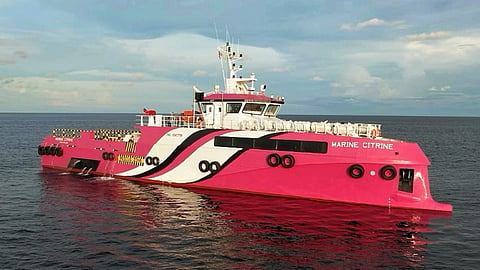
Malaysian shipowner Marine Citrine has taken delivery of a new fast crewboat built locally by Kaibuok Shipyard.
The vessel, which is also named Marine Citrine, is operated and managed by GOF Offshore. She is currently deployed in Sabah under Petronas, where her core daily duties consist of rapid personnel transfers, resupply, and deploying IMDG hazardous cargo materials directly to offshore platforms.
Design work on the crewboat was undertaken by Malaysia’s Mega Salutes Ship Design. The entire safety profile of the vessel is built to satisfy Bureau Veritas (BV) class requirements, ensuring the hull construction, structural fire protection and life-saving equipment meet strict international marine standards.
Marine Citrine has all-aluminium construction, an LOA of 45 metres (150 feet), a beam of eight metres (26 feet), a draught of only 1.55 metres (5.09 feet), and space for 80 technicians and 10 crewmembers.
The sleek, hydrodynamic hull form minimises resistance while maximising fuel efficiency and seakeeping capability, allowing the vessel to maintain high performance even in higher sea states with minimal slamming and pitching. The optimised hull provides superior stability, reduced motion, and enhanced passenger comfort, ensuring safe and efficient crew transfers throughout extended operations.
Comfortable accommodation coupled with hazardous payload certification
“A speed of 25 knots was once thought as a barrier for transit speed at load for this class of fast crewboat,” Arvin Puan, Kaibuok Shipyard Director, told Baird Maritime. “Marine Citrine was built to defy this barrier by achieving 30 knots at 70 DWT without any increase in engine power.”
Puan added that the crewboat balances a dual-mission profile. She boasts a high-capacity, business-class lounge with calf rests as well as an expansive 120-square-metre (1,300-square-foot) aft deck.
“Crucially, the deck is fully certified for IMDG cargo transit, enabling the vessel to safely deliver hazardous materials directly to remote offshore installations—a capability that sets a new benchmark for field utility.”
Puan said the operational brief dictated the construction of a robust, high-performance offshore service asset capable of executing rapid personnel transfers and critical logistics support in demanding open-ocean environments. The technical parameters necessitated a transit speed of 28 knots under a heavy 70-tonne cargo load, an optimised 1.55-metre draught to expand operational flexibility, and a reinforced deck rating of 2.5 tonnes per square metre to accommodate heavy oil field machinery and specialised tooling.
Platform built for heavy-duty daily use

“Central to the owner's strategic objectives was the delivery of an exceptionally seaworthy platform engineered to maximise operational efficiency and yield significant, measurable fuel savings across sustained deployment cycles,” added Jason Ting, Managing Director of Mega Salutes Ship Design.
“Marine Citrine also bridges the gap between slow utility boats and expensive helicopter logistics. By delivering a 28-knot transit speed under a heavy 70-tonne cargo load, alongside an extensive 98-cubic-metre (22,000-gallon) fuel capacity and 28-cubic-metre (6,200-gallon) freshwater capacity, she offers owners a highly cost-effective, high-speed regional logistics pipeline capable of sustained, multi-day field operations.”
Three Cummins KTA50-M2 diesel engines that each produce 1,800 hp (1,300 kW) at 1,900 rpm drive fixed-pitch propellers via Twin Disc MGX6848SC gearboxes to deliver a speed of 29 knots with a 70-tonne load. The propulsion machinery also includes two Cummins QSB7-DM 150ekW main generators, a Cummins 6CT8.3-DM 100kW auxiliary generator, and a Veth VT-90 bow thruster to facilitate precise station-keeping (during crew transfers) and platform berthing.
“The implementation of a triple-screw configuration offers exceptional operational flexibility,” Puan told Baird Maritime. “For high-speed dashes, all three Cummins engines can be fully engaged to reach 30 knots at a load of 70 DWT. During standby tracking or low-speed patrol duties within an oil field, the center engine can be disengaged, significantly optimising fuel economy and reducing engine hour wear.”
Enhanced safety and monitoring systems
The vessel is outfitted with a professional marine bridge package fully tailored for extended offshore operations. The communications suite is outfitted to satisfy full sea area A1 and A2 requirements, providing global maritime safety communication coverage, while the systems management setup includes an Ascenz integrated monitoring system to track fuel consumption and efficiency metrics in real time.
Critical systems were designed with redundancy and reliability in mind, ensuring continuous operation in demanding offshore environments.
“The bridge console layout is tightly integrated with the vessel's internal safety architecture, allowing rapid electronic monitoring of the hazardous cargo zones, emergency pump allocations, and safety parameters demanded by BV class and IMDG compliance frameworks,” said Ting.
The crewboat is also outfitted for external firefighting thanks to a FFS pump and monitor setup with a discharge rate of 1,200 cubic metres (260,000 gallons) per hour. This will enable the crew to immediately assist with offshore firefighting operations if an emergency arises at a platform or a field terminal.
“Inside the vessel, the accommodation spaces are designed around human comfort and operational efficiency,” Ting added. “Ergonomic seating, generous headroom, optimised lighting, low-noise interiors, and climate-controlled spaces provide a comfortable experience for crew and passengers alike. Every detail has been considered to reduce fatigue and improve onboard well-being during high-frequency offshore operations.”
The other key equipment includes: a rescue boat davit with an SWL of 1.5 tons that can also be used for cargo handling; a 260kg HHP anchor controlled by a heavy-duty hydraulic windlass.
“Separately, the vessel is equipped with advanced waste and sanitation systems below deck to support long-term operational autonomy,” said Ting. “The sub-deck compartments accommodate a 20-person biological sewage treatment plant configured for a 380V/3P/50Hz power supply, working alongside a high-efficiency oily water separator compliant with strict regional discharge standards. Waste processing is further optimised by an onboard garbage macerator unit.”
Incorporating a wave-piercing design and other innovative features to satisfy performance requirements
In Ting’s view the overriding challenge for Mega Salutes during the vessel’s design phase was developing a highly efficient hull with increased deadweight capable of meeting the client’s stringent speed benchmarks at the lowest practical fuel consumption, thereby strengthening the owner's tender competitiveness.
“Achieving this delicate balance required the engineering team to develop a state-of-the-art design with a new in-house-developed, third-generation wave-piercing hull, as it cannot be achieved with a conventional hull,” Ting told Baird Maritime. “It enables the lowest hydrodynamic resistance in all ranges of speed to maximise propulsive efficiency.”
Puan meanwhile remarked that executing the construction phase required resolving several distinct engineering complexities to ensure the vessel performed to its high technical specifications.
“Fabricating the all-aluminum structure with 5083 stock plates and 6061/6082 extrusions necessitated highly specialised, certified welding sequences to meticulously manage thermal distortion and preserve the hull's optimised hydrodynamic form. Mechanically, the engine room presented a separate set of precision demands, where seating and aligning three independent propulsion lines across a narrow stern required absolute geometric accuracy to ensure long-term shaft line integrity and avoid structural vibration.”
Puan said compounding these structural and mechanical tasks was the challenge of packaging a comprehensive array of high-capacity equipment within tight sub-deck confines. Technicians avoided a basic placement approach, opting instead for strategic spatial routing that organised all auxiliary systems – most notably the high-capacity external firefighting network – to guarantee both seamless operational utility for the crew and clear service access for maintenance teams.
“The design proved to be extremely efficient and up to 20 per cent more fuel efficient in all speed and high load conditions compared to any known conventional monohull of the same class,” Puan said. “Future vessels can therefore be based on this hull series.”
