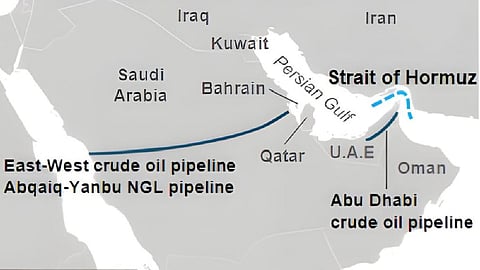


The disruption caused by the Iran war is forcing the energy industry to rethink its just-in-time approach to efficient supply chains and to consider investing in alternative routes which bypass the Persian Gulf and the Red Sea.
Attacks on shipping around the Strait of Hormuz and the Bab el-Mandeb Strait have cut energy exports, boosting prices and inflation globally.
"The biggest lesson of the crisis is that we need not only to think to produce but also to export," said TotalEnergies CEO Patrick Pouyanne adding the industry needed to move from a just-in-time to a just-in-case mindset.
He reiterated Total's plans to participate in an Iraq-to-Syria pipeline and invest in doubling capacity for a pipeline system into the UAE port of Fujairah to bypass Hormuz.
"It's obvious to me that I need to participate in this infrastructure," Pouyanne said.
BP's redevelopment of the Kirkuk oilfield alongside ConocoPhillips and Turkey's state-owned TPAO has opened the option of new northern export routes, BP CEO Meg O'Neill said.
"We know the Iraqi Government is working very hard on alternative export routes," O'Neill said. She wasn’t sure, however, that would be a good use of BP shareholder money but said it might be a good fit for other investors.
BP, which is trying to cut debt, has been selling stakes it owns in some pipelines.
Chevron CEO Mike Wirth said he was optimistic about the US company's negotiations with the Iraqi Government on entering the West Qurna 2 and Nassiriya oilfields. Earlier this year, the company signed an initial agreement with Iraq to study possible new pipelines to carry oil to the Mediterranean ports at Ceyhan in Turkey or Baniyas in Syria.
Still, he cautioned that others might have to provide the majority of the funding. "It's not the kind of thing we tend to put a lot of our own capital into," Wirth said. "I think we'd be one player in a multi-party consortium that might do something like that."
The chief executive of Kuwait Petroleum Corporation said he was in discussions with Saudi Arabia and the United Arab Emirates on new pipelines to their ports but he said importers of oil had a responsibility to pay.
"We cannot throw the responsibility completely upon the producers and say you must do, make all the investments and make everything available to us," Shaikh Nawaf Al-Sabah said. "There is a shared responsibility."
(Reporting by Shadia Nasralla, Stephanie Kelly and Robert Harvey in London; Editing by Sanjeev Miglani)
