
PLATFORM REVIEW | Floating energy reservoir capable of power distribution using brine
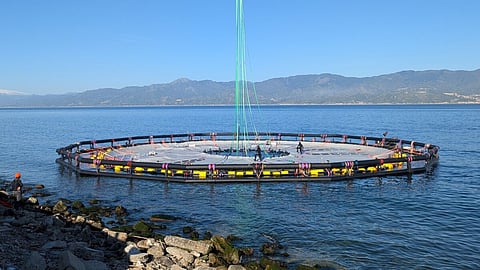
Milan-based technology company Sizable Energy has completed the installation of a new energy storage tank prototype in the Mediterranean Sea off southwestern Italy.
The prototype has been installed within the University Mediterranea of Reggio Calabria’s Natural Ocean Engineering Laboratory (NOEL), one of Italy's major offshore test sites for marine energy technologies off the coast of Calabria. The system has been designed to store electricity produced by offshore wind turbines or other renewable energy sources and then deliver it back to the grid when demand increases.
Logistics company Geodis, which provided logistical support for the storage tank's installation, said the technology that went into the structure will help strengthen the stability of a local power grid while providing an alternative to conventional battery energy storage systems.
Scalable technology to better suit regional energy requirements

The offshore reservoir measures 50 metres (160 feet) in diameter and weighs approximately 11 tonnes. Its launch required the use of a 350-tonne crane to perform a lift with an outreach of approximately 50 metres to meet the site constraints and environmental requirements.
Flexible HDPE was used for the reservoir’s membranes due to its low cost, which will then allow for economies of scale with an increase in system capacity. Also, because HDPE is lightweight, the system can be deployed without having to lower large, heavy structures onto the seabed.
The technology developed by Sizable Energy functions like a large battery for the electrical system. The principle is the same as that of pumped hydro plants built in Italy over the past century, primarily in the north, which balance electricity production and consumption and help prevent blackouts.
Sizable Energy said it is a system that was already in use before the expansion of wind and solar power, and it is even more essential today with the growing deployment of renewable sources that are economical but not dispatchable.
Economic alternative to traditional hydro-electric plants
Unlike traditional pumped hydro facilities that rely on elevation differences between mountain reservoirs, Sizable Energy’s technology uses hydrostatic pressure and gravity offshore. Excess energy is used to pump a brine solution that is denser than seawater into a floating reservoir. When energy is needed, the fluid is released toward a second reservoir on the seabed, driving turbines that produce electricity to be returned to the grid.
According to Sizable Energy, “a few hundred thousand tons” of brine would suffice for achieving one gigawatt-hour of energy storage. Brine would also present only minimal impediments with regards to sourcing since it is naturally occurring and is inexpensive despite being heavier than seawater.
The system was designed to minimise visual impact from the coast and does not rely on rare or potentially polluting materials. Sizable Energy said this approach enhances energy security by enabling better integration of renewable energy into the power system without harming the landscape or the sea.
NOEL was selected for the deployment as it offers a unique environment: in this case, a natural basin where actual ocean waves make it possible to test marine structures under scaled, authentic operating conditions.
